Shortest Summary:
In 2005, pharmacists from College of Pharmacy at Nova Southeastern University published a hit-piece against the safe and effective anti-inflammatory herbal treatment “white willow bark” (Salix alba); my published critique of their article showed that all of their fearmongering statements were plainly invalid and already widely known to be false—furthermore and despite that the article was written by pharmacists and pharmacologists and published from a university-based “College of Pharmacy”, all of their pharmacology data was completely wrong as they failed to understand the differences between salicylate and acetylsalicylate: Vasquez A, Muanza DN. Comment: evaluation of presence of aspirin-related warnings with willow bark. Ann Pharmacother 2005 Oct;39(10):1763 doi: 10.1345/aph.1E650a

Medical propaganda isn’t simply about overstating the benefits and understating the risks of drugs, but also relentlessly attacking Nutrition and other nondrug/nonsurgery preventives and treatments so that patients and politicians will be scared into drug dependency.
Background and Details:
In 2005, pharmacists from College of Pharmacy at Nova Southeastern University (Palm Beach Gardens, Florida) published a propagandistic hit-piece against the herbal medicine “white willow bark” formally known as Salix alba; to the journal’s discredit, their propaganda was published in the supposedly peer-reviewed and edited journal Annals of Pharmacotherapy:
Clauson KA, Santamarina ML, Buettner CM, Cauffield JS. Evaluation of presence of aspirin-related warnings with willow bark. Ann Pharmacother. 2005 Jul-Aug;39(7-8):1234-7. doi: 10.1345/aph.1E650
Biased and alarmist language (from their abstract):
may present a safety risk to people
cautions on its label.
warnings related to salicylates c
potentially dangerous lack of information exists. …
warning regarding aspirin sensitivity
Reye’s syndrome
interactions with anticoagulants/”blood thinners”
dearth of information
potential safety risks
greater danger to at-risk patients
Counseling of patients who take dietary supplements
improve the situation
requirements for dietary supplement labeling
fully address this problem.
Summarizing their work in the abstract, the authors wrote:
Background: The dietary supplement willow bark, also known simply as willow, contains salicylates that may present a safety risk to people. Current regulations do not require willow bark to include any cautions on its label.
Objective: To evaluate the absence or presence of label warnings related to salicylates contained in willow bark to ascertain whether a potentially dangerous lack of information exists. …
Results: A total of 58 willow bark-containing and 12 single-ingredient willow bark products were assessed. Of the 70 products evaluated, only 8.6% listed a warning. The warning regarding aspirin sensitivity was present on 4.3%, Reye’s syndrome was 2.9%, and interactions with anticoagulants/”blood thinners” was 4.3%. One product was labeled as aspirin-free. Percentages were lower on Web sites.
Conclusions: There is a dearth of information regarding potential safety risks on the labels of willow bark and willow bark-containing products. Combination products containing willow bark may pose a greater danger to at-risk patients based on their sheer volume. Counseling of patients who take dietary supplements can improve the situation; however, it may ultimately take improved requirements for dietary supplement labeling to fully address this problem.
THEIR ERROR: All of their pharmacology data was completely wrong as they failed to understand the differences between salicylate and acetylsalicylate.
MY PUBLISHED CORRECTION:
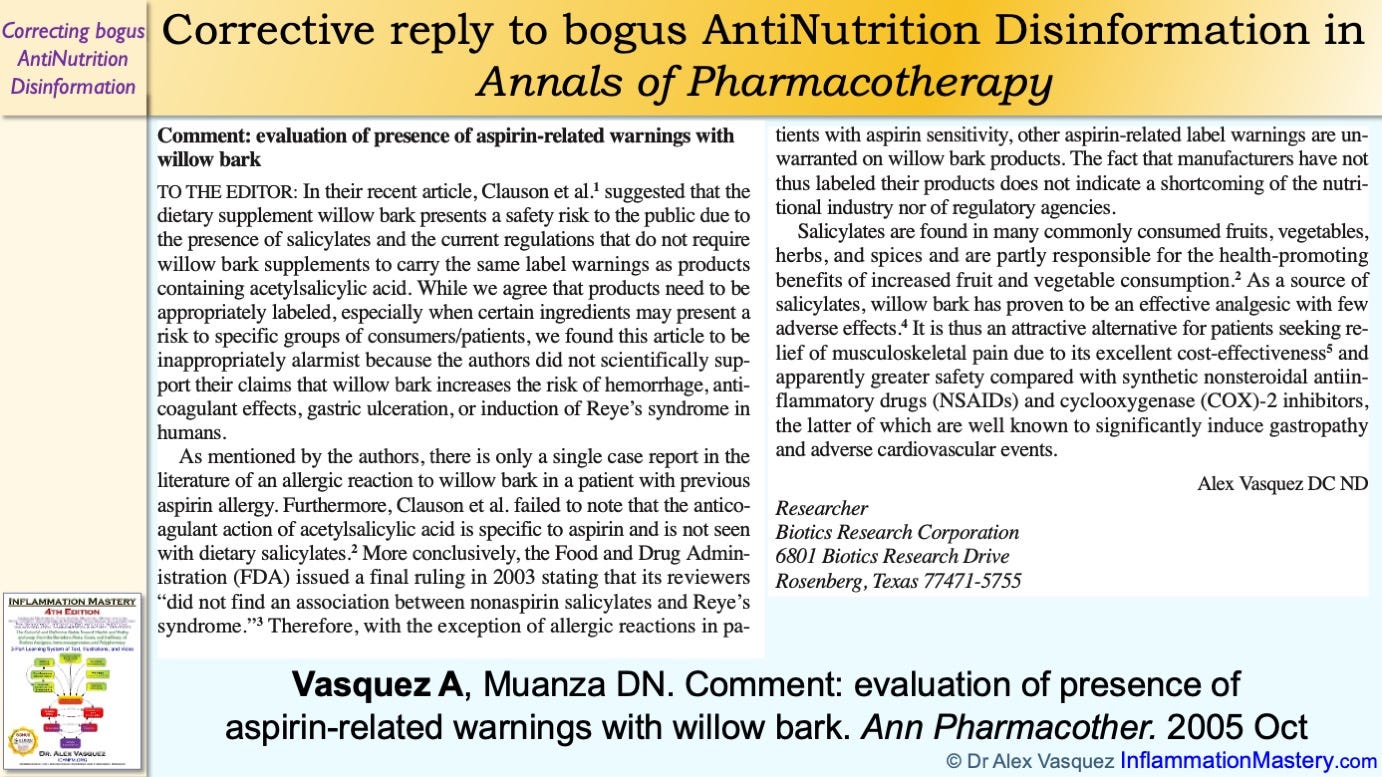
Comment: evaluation of presence of aspirin-related warnings with willow bark
TO THE EDITOR: In their recent article, Clauson et al.1 suggested that the dietary supplement willow bark presents a safety risk to the public due to the presence of salicylates and the current regulations that do not require willow bark supplements to carry the same label warnings as products containing acetylsalicylic acid. While we agree that products need to be appropriately labeled, especially when certain ingredients may present a risk to specific groups of consumers/patients, we found this article to be inappropriately alarmist because the authors did not scientifically support their claims that willow bark increases the risk of hemorrhage, anticoagulant effects, gastric ulceration, or induction of Reye’s syndrome in humans.
As mentioned by the authors, there is only a single case report in the literature of an allergic reaction to willow bark in a patient with previous aspirin allergy. Furthermore, Clauson et al. failed to note that the anticoagulant action of acetylsalicylic acid is specific to aspirin and is not seen with dietary salicylates.2 More conclusively, the Food and Drug Administration (FDA) issued a final ruling in 2003 stating that its reviewers “did not find an association between nonaspirin salicylates and Reye’s syndrome.”3 Therefore, with the exception of allergic reactions in patients with aspirin sensitivity, other aspirin-related label warnings are unwarranted on willow bark products. The fact that manufacturers have not thus labeled their products does not indicate a shortcoming of the nutritional industry nor of regulatory agencies.
Salicylates are found in many commonly consumed fruits, vegetables, herbs, and spices and are partly responsible for the health-promoting benefits of increased fruit and vegetable consumption.2 As a source of salicylates, willow bark has proven to be an effective analgesic with few adverse effects.4 It is thus an attractive alternative for patients seeking relief of musculoskeletal pain due to its excellent cost-effectiveness5 and apparently greater safety compared with synthetic nonsteroidal antiinflammatory drugs (NSAIDs) and cyclooxygenase (COX)-2 inhibitors, the latter of which are well known to significantly induce gastropathy and adverse cardiovascular events.
The medical “profession” uses a wide range of unscrupulous tactics in its relentless attacks against nutrition and other nondrug/nonsurgery preventives and treatments so that patients and politicians will be scared into drug dependency.
AntiNutrition Fraud (1) Medical Schools-Journals publish incompetent “nutrition research” to feign inefficacy and toxicity to promote drug sales, medical hegemony/profitability, and social control
While I have been broadly reading biomedical and nutrition research for more than 30 years and I started publishing my own research articles in 1994, I started to write an article specific to “Anti-Nutrition Fallacies and Inconsistencies in Politics and Medicine” and posted the first version to academia.edu/45018439 in February 2021. Unfortunately, the original document is lost (at least for now) but I have recovered my archived PDF copy and included it below:
My plan (among many projects) is to formalize this document into a publishable article, and—in the process of that organization—review each component in text/video format. For example, my recent video review of the bogus propaganda from Harvard will be more concisely summarized and filtered of its colorful vernacular.
The archived video below contains a similar critique; I have marked this page for repair since it contains additional video links that are no longer functioning due to the Vimeo censorship of my video archives in 2025.
Thank you for supporting this archive of information for the cost of a coffee while I am working—about $4.20—for the hours, days, months and years developing this archive which now contains more than 1,000 pages and hundreds of hours of videos …
….on a wide range of topics including Clinical Nutrition (including the Vitamin D series of Videos and Scientific Publications), Antiviral Strategies, Microbiome+Dysbiosis (CME series of >12 videos), Functional Medicine (conference videos) and Pharmacology (of Vitamin B12 and Pediatric Injections,.. Leadership, Critical Analysis of Research and Social Events, architecture, music (Celibidache), philosophy, and a few tutorial videos on fun topics like how to select a good wine/whiskey (and minimize the risks)! HealthyThinking.substack.com includes a wide range of topics including music, politics, architecture, logic, philosophy, recipes (ie, “everything”) plus “Health Homework” (series) to inform and remind you about important health-promoting actions…whereasInflammationMastery.substack.com attempts to be more/strictly clinical and specific to book updates, clinical research and protocols.