

Update: This page was originally published in October 2022 and was edited, clarified, embellished, redefined and republished in January 2026.
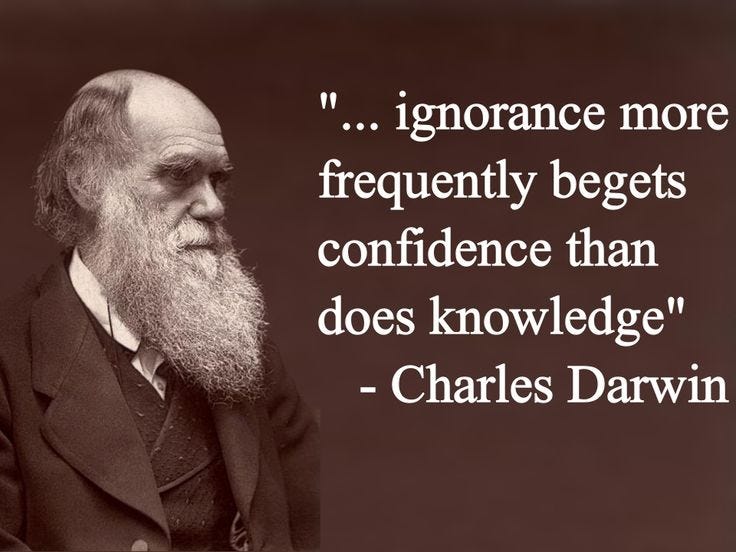
Here are my 3 components (listed below) and progressive levels characterizing Dunning-Kruger people: for this reason, I have come to predict that incompetent people are potentially dangerous, and when I have to interact with someone who later shows themself to be incompetent, I immediately start looking for the accompanying arrogance and potential entitlement and risk.
I am sure that most adults have heard of this phrase “Dunning-Kruger” so here I will provide 1) the common explanation, 2) additional details, 3) some of my own experiences especially with accountants and attorneys and academic administrators, and 4) the original PDF publication (at the bottom of the page).
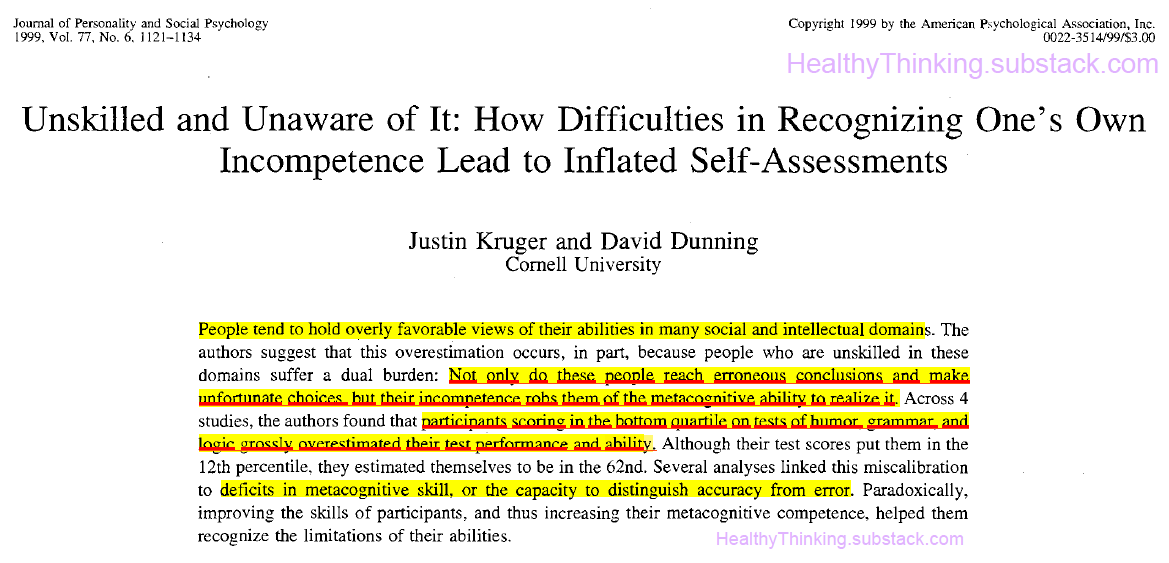
Dunning-Kruger effect/syndrome: This concept derives from two Cornell Researchers who published their elegant study in 1999 in Journal of Personality and Social Psychology.
Common shorthand explanation: “when people are too stupid to know that they are stupid.”
Incompetence + blindness + arrogance: People who lack 1) the ability to gain competence and who also lack 2) the ability to accurately perceive their own incompetence are demonstrating a “metacognitive” defect. They cannot see what they are doing wrong, and they therefore assume they are doing everything correctly. Notice that this is not the same response as we would expect in an uninformed-inexperienced student, who—even though not skilled or knowledgeable—can see and acknowledge his/her errors and continue to work hard to gain mastery; this honesty and humility are exactly what is missing among people who are later described as having “Dunning-Kruger syndrome.” As such, a good way to think about Dunning-Kruger syndrome is that it combines 1) incompetence, 2) lack of self-awareness, and 3) lack of humility to see one’s shortcomings—this latter problem of arrogance also gives these people an unfounded and inappropriate sense of entitlement over other people, which has the potential to be dangerous.
Additional details: here are the two additional parts that most people miss if they have not read the complete publication:
Resistance to learning, unteachable: Dunning-Kruger people are not simply ignorant, but when they are shown their errors, they do not incorporate the experience in order to improve. They stay stuck.
Dunning-Kruger people (DKpeople) are not simply ignorant, but they are defensively ignorant. This—in my opinion and experience—is where incompetence becomes dangerous; because these DKpeople cannot see their faults, yet they still think they are correct and entitled, so that the only solution available to them is to assume the right to status and power that they don’t deserve, have not earned, and cannot manage.
Some of my own experiences especially with accountants and attorneys and academic administrators: These are numerous and detailed in various videos, so I have provided the links below.
Original PDF publication: “Unskilled and unaware of it: How difficulties in recognizing one’s own incompetence lead to inflated self-assessments” in Journal of Personality and Social Psychology 1999 is provided below, at the end of this page

A good way to think about Dunning-Kruger syndrome is that it combines 1) incompetence, 2) lack of self-awareness, and 3) lack of humility to see one’s shortcomings—this latter problem of arrogance also gives these people an unfounded and inappropriate sense of entitlement over other people, which has the potential to be dangerous.
SHORT STORY: My childhood friend became Dunning-Kruger, assuming he had social clout that he never earned
Childhood friendships don’t necessarily translate into Adult Friendships—nor should we expect them to.
I had a recent negative experience with a long-term friend that didn’t actually surprise me because I have observed how he has changed over the past few years. My friend had gone from being somewhat of a lifelong drifter (albeit a pleasant drifter) to someone who now thinks of himself as being highly successful, accomplished, and elite because he married someone with big money. His behavior finally became unacceptable even if it was perfectly predictable given his trajectory, so I ended the friendship, blocked his phone number, and called it done: thanks for the memories—CHAO!
My friend had become Dunning-Kruger on many levels, because he thought that marrying someone who had made money meant that he was capable of same (benign error) and that this catapulted him into the social-intellectual-financial elite of humanity (bigger error) and that he could now mistreat people at his whim (dangerous error). Like I’ve said before among other lessons learned, “In societies that praise money, rich people are too-commonly assumed to be good, pure, and truthful and somehow ‘better than other people.’”
I learned that childhood friendships don’t necessarily translate into adult friendships—nor should we expect them to. For childhood friendships, we are mostly looking for fun/companionship and acceptance, while adult relationships are more complex because our needs, wants, expectations, and standards have changed at 50 years-of-age from what they were at 15 years-of-age.
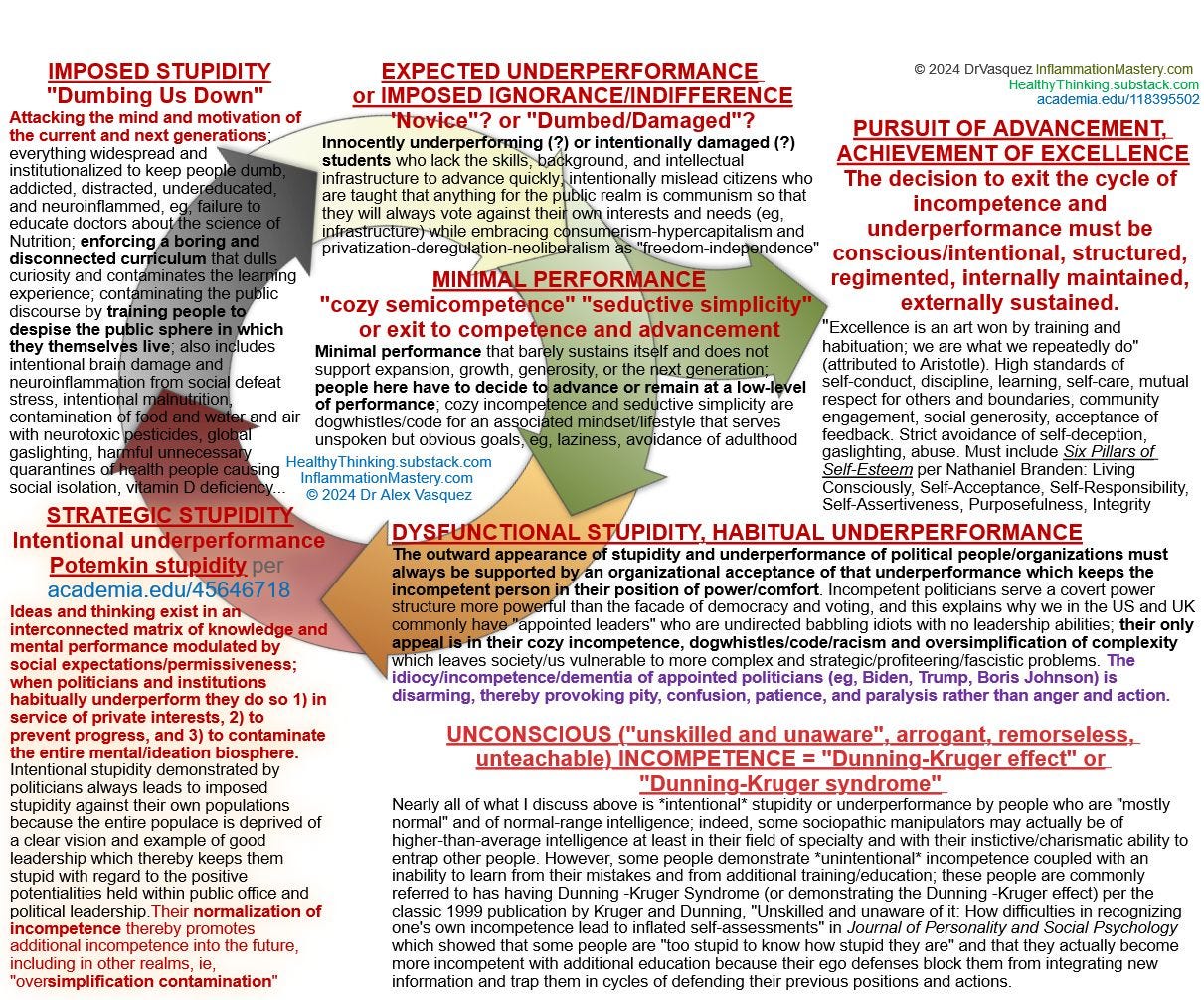
Of course, I reflected on the events for several days, and tried to understand how what happened fit into my understanding of fallacies, mistakes, etc. His behavior actually did not fit either fallacy (see recent video) nor stupidity per se (see previous model, now updated below), so that I had to review the Dunning-Kruger syndrome/effect and also update the diagram provided toward the end of this page.
Dunning-Kruger triad= 1) incompetence, 2) unawareness, and 3) arrogance, entitlement which might become dangerous, or at least manipulative
Some people demonstrate *unintentional* incompetence coupled with an inability to learn from their mistakes and from additional training/education; these people are commonly referred to has having Dunning-Kruger Syndrome (or demonstrating the Dunning-Kruger effect) per the classic 1999 publication by Kruger and Dunning, “Unskilled and unaware of it: How difficulties in recognizing one’s own incompetence lead to inflated self-assessments” in Journal of Personality and Social Psychology which showed that:
Some people are “too stupid to know how stupid they are.”
They actually become more incompetent with additional training/education because their ego defenses block them from integrating new information and trap them in cycles of defending their previous positions and actions.
My extension is the social implication of incompetence+unawareness: When people are too dumb to succeed and too arrogant to admit their shortcomings, their only means for satisfying their desires is to steal from others, in various ways.
In summary: Dunning-Kruger = arrogance + incompetence/ignorance, especially incompetence/ignorance that gets worse with time, which is the opposite of what occurs with normal-healthy people, who learn more skills and information with time and who generally improve their abilities to self-reflect and self-correct.
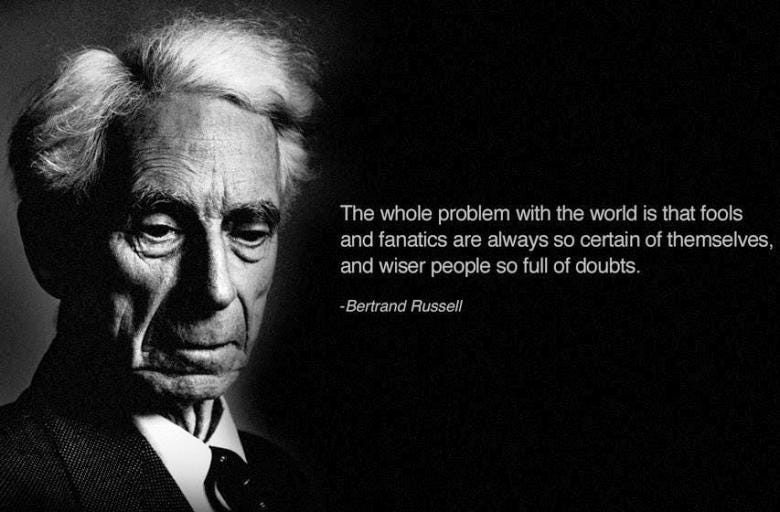
Here are my 3 components (listed below) and progressive levels characterizing Dunning-Kruger people: for this reason, I have come to predict that incompetent people are potentially dangerous, and when I have to interact with someone who later shows themself to be incompetent, I immediately start looking for the accompanying arrogance and potential entitlement and risk:
1. LEVEL ONE—FRUSTRATING: In normal circumstances with someone who is Dunning-Kruger but not psychopathic/antisocial/violent, their Dunning-Kruger is something of a frustrating or almost-laughable inconvenience—we don’t have to accept their behavior but at least the danger level is low. The combination of arrogance + inability to reflect/integrate = highly frustrating for everyone other than the chief actor.
“Dunning–Kruger effect is a cognitive bias whereby people with low ability, expertise, or experience regarding a certain type of a task or area of knowledge tend to overestimate their ability or knowledge.” Wikipedia
2. LEVEL TWO—MANIPULATIVE: But what if that same person with Dunning-Kruger syndrome is also mildly psychopathic? They will probably be manipulative and socially/emotionally harmful to others. If you see this combination, then the best advice is to leave, move, get away.
3. LEVEL THREE—DANGEROUS: What if they are more psychopathic? Then they are a life-and-death physical threat to others. The combination of arrogance + inability to reflect/integrate + willingness to be violent/ruthless = recipe for disaster. In fact, if you look at the basic profile of most serial killers, their psychographic pattern is exactly entitlement + un(self)reflective + ruthless. If you want to see a real-world example of this combination, you can see several news items and video documentaries on Daniel Wozniak, the charismatic actor who became a double killer simply in order to pay for a short vacation with his wife.
Perhaps a sequence of severity is as follows:
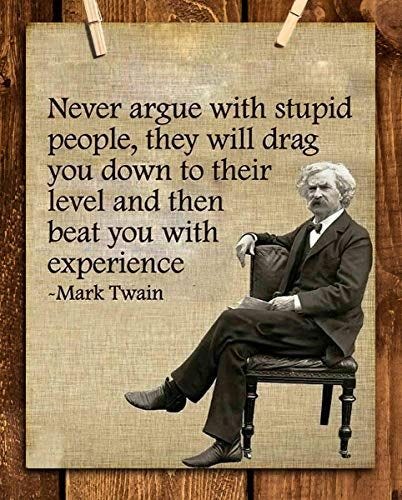
Ignorance can be innocent.
Incompetence is problematic, because by definition it means that someone is underperforming for a role that they could and should be prepared for; the team/organization/nation/society is being held back, retarded, or harmed because of someone’s underperformance.
Stupidity among adults is commonly self-serving in some way (which might be relatively/temporarily benign) or it may be strategic, in which case it is intentional and therefore designed to harm other people.
Dunning-Kruger is reckless and non(self)correcting, so it is either going to be a small problem or a big problem, depending on the situation and the person’s tendency for ruthlessness.

3. Some of my own experiences especially with accountants and attorneys and academic administrators: These are numerous and detailed in various videos, so I have provided the links below.


4. My highlighted annotated PDF of Kruger and Dunning, “Unskilled and unaware of it: How difficulties in recognizing one’s own incompetence lead to inflated self-assessments” in Journal of Personality and Social Psychology 1999 is provided below for convenience (the article is also widely available on the internet)
DrV’s Newsletter, Notes, Essays, Articles, Videos, and Book Chapters is a reader-supported publication. To receive new posts and support my work, consider becoming a free or paid subscriber.
