Note: Since this is a long detailed text post, you might want to have the article read to you as you follow along using the Substack app:

Importance and Background: Vitamin D provides a wide range of health benefits when administered appropriately at physiologic doses per the guidelines I published in 2004 and 2005:
Dosages of vitamin D must reflect physiological requirements and natural endogenous production and should therefore be in the range of 3,000-10,000 IU daily.
Vitamin D supplementation must be continued for at least five to nine months.
The form of vitamin D should be D3 rather than D2.
Supplements should be assayed for potency.
Effectiveness of supplementation must include measurement of serum 25-hydroxyvitamin D.
Serum 25(OH)D concentrations must enter the optimal range, which is 40-65 ng/ml (100-160 nmol/l).
Published in: Vasquez A, Cannell J. Calcium and vitamin D in preventing fractures: data are not sufficient to show inefficacy. BMJ. 2005 Jul 9;331(7508):108-9; author reply 109. doi: 10.1136/bmj.331.7508.108-b. PMID: 16002891; PMCID: PMC558659 and Vasquez A, Manso G, Cannell J. The clinical importance of vitamin D (cholecalciferol): a paradigm shift with implications for all healthcare providers. Altern Ther Health Med. 2004 Sep-Oct;10(5):28-36; quiz 37, 94. PMID: 15478784

However, these guidelines were 1) based on available data and experience that we had at the time, which by now has advanced, 2) targeting the general population and addressing the need for a paradigm shift among healthcare providers in general practice rather than as discussed herein the use of vitamin D for the treatment of autoimmune diseases within a more specialized clinical context.
Today’s review distinguishes two different clinical approaches:
PHYSIOLOGIC: Vitamin D dosage and monitoring at minimal physiologic levels (eg, 4,000-15,000 IU) with 1) no dietary change, 2) minimal nonspecialized laboratory surveillance.
PHARMACOLOGIC: Vitamin D dosage and monitoring at maximal physiologic levels (eg, 30,000- >70,000 IU) with 1) strict dietary change, 2) specialized laboratory surveillance. Of note, we—in Orthomolecular Medicine and Clinical Nutrition—traditionally use the phrase “pharmacologic dosing of nutrients” when we are using supremely high levels of nutrients not for their physiologic effects but for an “off-target” effect whereby the nutrients is functioning more like a drug than a nutrient; this is a “soft distinction” not a “hard definition” but nonetheless has value, at least conceptually and as communication shorthand among experts. However, vitaminD3 does not lend itself to “pharmacologic dosing” because above 80,000 IU and certainly by 100,000 IU, the pharmacokinetics and resulting pharmacodynamics are so abnormal that we result with neutralizing effects rather than additive or synergistic effects. However, we can still use the phrase “pharmacologic” in this setting of higher dosages of vD3 because we are using the nutrient not for its “traditional” nutritional roles but for a therapeutic drug-like benefit. The dose is still “physiologic” because it is perfectly aligned with possible yet higher-than-normal endogenous production; however, we can describe it as “pharmacologic” because we are looking for a disease-modifying drug-like benefit.
Context: Because of vitaminD’s safety and effectiveness, it is a target of attack from the medical industry that seeks to safeguard its social dominance and professional profitability via disinformation strategies that use manipulated “scientific publications” to “prove” that nutritional nondrug nonsurgical interventions are “dangerous” and “ineffective.”
Two recent examples of this intentional misrepresentation of the clinical sciences published in 2026 have been reviewed per the linked pages/videos below:


Because 1) most medical doctors, journalists, and politicians have no training in Nutrition (eg, 1.Basic, 2.Clinical, 3.Functional) and therefore 2) cannot detect and decipher the fraud published in major medical journals from major academic institutions, and because 3) these same doctors, journalists, and politicians are taught to accept-without-questioning anything and everything published in major medical journals from major academic institutions, the necessary service provided by these expert-level critiques is to clarify the defects and strategies in these propagandistic publications in order to educate the audience and provide some “friction to the machine” of drug profiteering and social domination.
Today’s reviewed article:
Title: Safety Data in Patients with Autoimmune Diseases during Treatment with High Doses of Vitamin D3 According to the “Coimbra Protocol”.
Authors: Amon U, Yaguboglu R, Ennis M, Holick MF, Amon J.
Citation: Nutrients 2022 Apr 10;14(8):1575
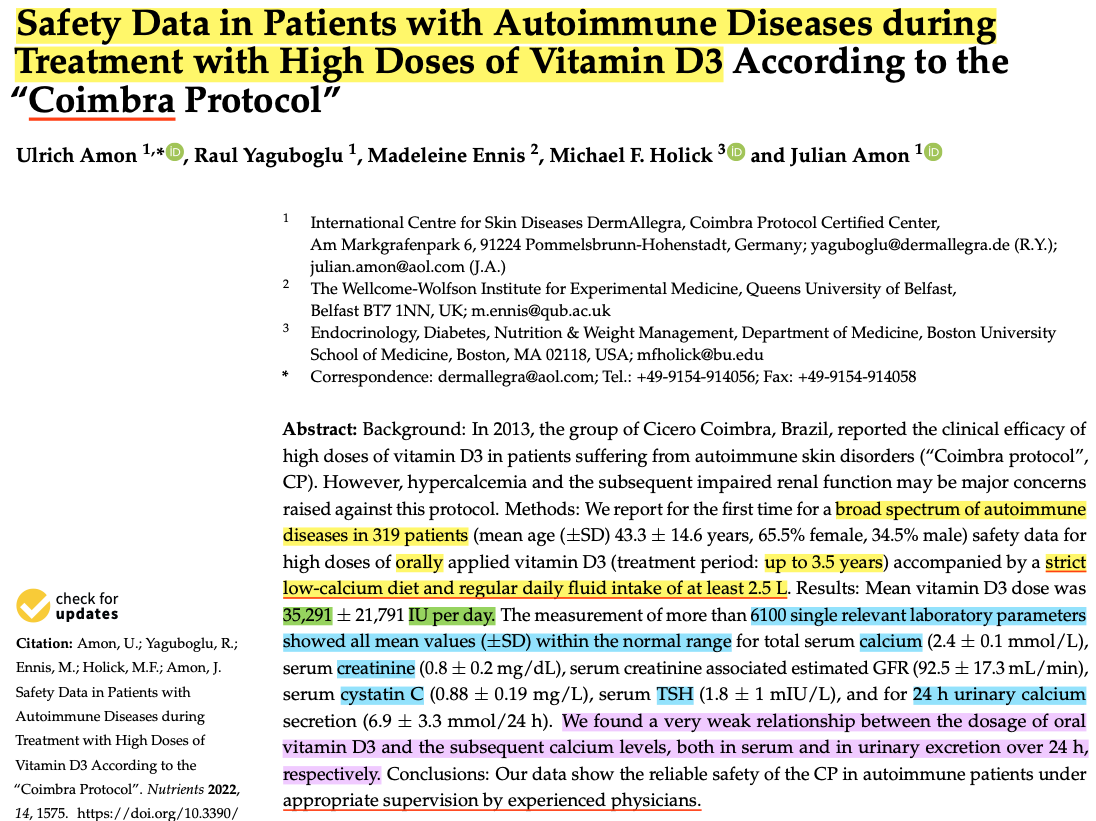
My comments on this paper (Amon et al. Safety Data in Patients with Autoimmune Diseases during Treatment with High Doses of Vitamin D3 According to the “Coimbra Protocol”. Nutrients 2022 Apr) are provided at the bottom of this page along with my annotated PDF copy of the article.
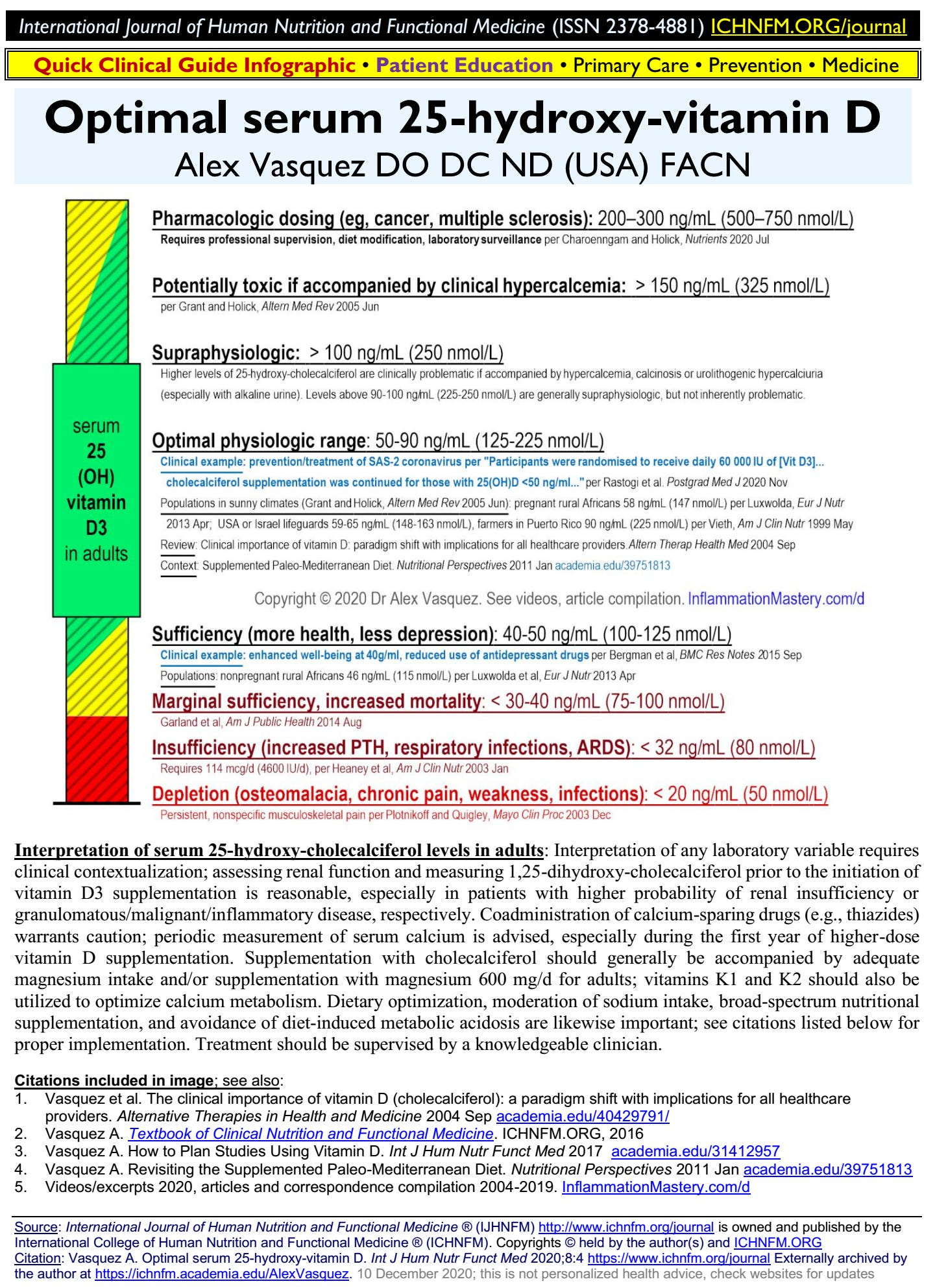
See my “vitamin D optimization” infographic for perspective and interpretation of these serum 25ohD levels: