

Business, Legal, and Social Insights from Oct2025:
Psychopaths and narcissists come in all shapes and sizes:
Attorneys
ACCOUNTANTS (!!!)
Bosses, coworkers
Friends and family (yes—including parents and children), including romantic partners,
Presidents
Globalists and “philanthropists”
Remember that you can listen to this article in the substack app; I attempted a few audio versions of this, but none of them have come out with the quality that I want, but I might keep trying.

A generally accepted fact of sociology and psychology is that approximately 5% to 10% of the human population is mildly to overtly psychopathic, and therefore neurologically programmed to at least be indifferent to the suffering of other people or possibly mentally deranged to the point that they actually enjoy the suffering of other people.
If you’re not actively defending yourself against psychopathic people and businesses, then you’re probably being abused; you have to become aware, see it, and protect yourself. So let’s reasonably state that 65% of the population are untrustworthy zombies and 10% are overt or covert psychopaths/sociopaths; that gives us 75% of the population—3 per 4 free-living people in the population—are potentially dangerous. As such, you and I are interacting with psychopaths and sociopaths every single day of our lives when we interact with any group of people.
The more intelligent and honest you are, the more you’re likely to be a vulnerable target to psychopaths and narcissists because they will turn your best qualities against you.
When they perceive you to be honest, they know that you assume other people are also honest, so that buys them time to manipulate you.
When they know that you are intelligent, they know they can deceive you with signs and sounds and undercut your intelligence with scheming and manipulation.
In the following article (to be posted later this week), I will talk about 3 important and necessary strategies that must be used with narcissists and psychopaths.
You have to be aware of yourself first and then set up a specific system to protect yourself that doesn’t rely on active vigilance and attentive observation. Attention fades and people can be deceptive, but rules and systems are solid, objective and reliable.
“What is the highest of all species of being, and what is the lowest? The parasite is the lowest species; he, however, who is of the highest species feedeth most parasites. For the soul which hath the longest ladder, and can go deepest down: how could there fail to be most parasites upon it? The most comprehensive soul, which can run and stray and rove furthest in itself; the most necessary soul, which out of joy flingeth itself into chance: The soul in Being, which plungeth into Becoming; the possessing soul, which seeketh to attain desire and longing. The soul fleeing from itself, which overtaketh itself in the widest circuit; the wisest soul, unto which folly speaketh most sweetly. The soul most self-loving, in which all things have their current and counter-current, their ebb and their flow—oh, how could THE LOFTIEST SOUL fail to have the worst parasites?” Friedrich Nietzsche in Thus Spoke Zarathustra
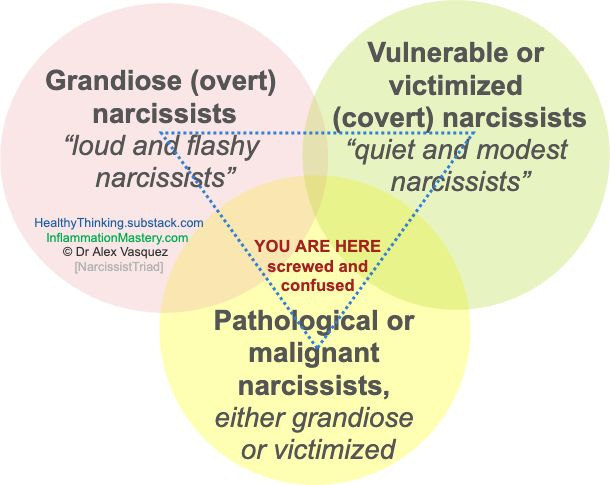

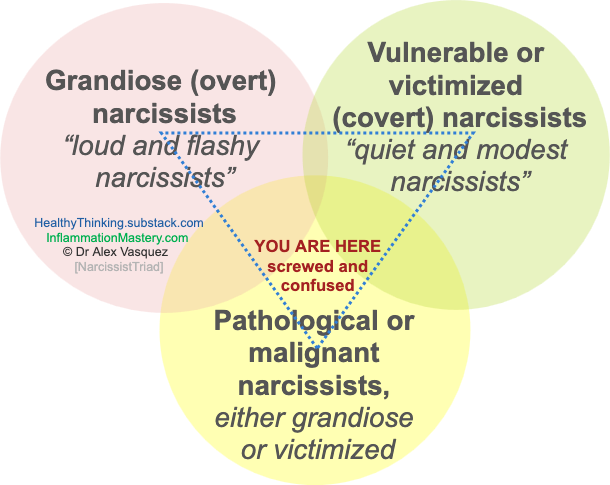
You need to appreciate three different types of narcissists:
1. Grandiose (overt) narcissists—“loud and flashy narcissists”:
Narcissists with inflated egos who demand attention and who usurp the property, attention, time, and rights of others. The central common theme of different types of narcissists is that they require and steal the time, attention, and resources of other people.

2. Vulnerable or victimized (covert) narcissists—“quiet and modest narcissists”:
These are controlling psychopaths who use the narcissistic technique of always being vulnerable and victimized, and therefore always being in the center of attention and requiring help and resources from other people. Again, the central common theme of different types of narcissists is that they require and steal the time, attention, and resources of other people.
