In 2001, Dr Elina Hypponen (PhD, Epidemiology) published one of the most important studies in the history of medicine in general and endocrinology and immunology in particular; no doubt that she should have won or shared the Nobel Prize for her findings, which deserved immediate follow-up and implementation.
If the medical profession had jumped onto this treatment just like they jump onto every other drug and injectable—which they happily do with essentially zero evidence, other than pharmaceutical advertising—then type-1 diabetes would’ve been mostly eliminated by now or at least reduced by about 80%, which would’ve been a miracle breakthrough that no drug will ever achieve.
But because the medical profession/cult categorically refuses to acknowledge the importance of interventional nutrition, even her massive findings (78% effectiveness) in a massive cohort (more than 10,000 humans), her findings were completely ignored, just like the similar findings using vitamin D against infections with 80% lifesaving efficacy, as I reviewed in video:

Contributing to the failed uptake and implementation of their publication was the assumption that doctors would read and understand what was being said. Here, I will contrast two of their headlining statements (polite and passive) with my own version (more direct and explicit).
HOW THEY TITLED IT: “Intake of vitamin D and risk of type 1 diabetes: a birth-cohort study.”
THE WAY I WISH THEY HAD TITLED IT: “Safe and Massive reduction in type-1 Diabetes by Immunomodulating Vitamin D3”
HOW THEY SUMMARIZED IT: “Dietary vitamin D supplementation is associated with reduced risk of type 1 diabetes. Ensuring adequate vitamin D supplementation for infants could help to reverse the increasing trend in the incidence of type 1 diabetes.”
THE WAY I WISH THEY HAD SUMMARIZED IT: “Dietary vitamin D supplementation at 2,000 IU per day dose-dependently and safely reduced the incidence of type-1 autoimmune diabetes by approximately 80%, thereby providing a breakthrough in the prevention of this illness with probable applications to other immune-related disorders.”
Source and abstract:
Hyppönen E, Läärä E, Reunanen A, Järvelin MR, Virtanen SM. Intake of vitamin D and risk of type 1 diabetes: a birth-cohort study. Lancet. 2001 Nov 3;358(9292):1500-3. doi: 10.1016/S0140-6736(01)06580-1. PMID: 11705562.
Background: Dietary vitamin D supplementation is associated with reduced risk of type 1 diabetes in animals. Our aim was to ascertain whether or not vitamin D supplementation or deficiency in infancy could affect development of type 1 diabetes.
Methods: A birth-cohort study was done, in which all pregnant women (n=12055) in Oulu and Lapland, northern Finland, who were due to give birth in 1966 were enrolled. Data was collected in the first year of life about frequency and dose of vitamin D supplementation and presence of suspected rickets. Our primary outcome measure was diagnosis of type 1 diabetes by end of December, 1997.
Findings: 12058 of 12231 represented live births, and 10821 (91% of those alive) children were followed-up at age 1 year. Of the 10366 children included in analyses, 81 were diagnosed with diabetes during the study. Vitamin D supplementation was associated with a decreased frequency of type 1 diabetes when adjusted for neonatal, anthropometric, and social characteristics (rate ratio [RR] for regular vs no supplementation 0.12, 95% CI 0.03-0.51, and irregular vs no supplementation 0.16, 0.04-0.74. Children who regularly took the recommended dose of vitamin D (2000 IU daily) had a RR of 0.22 (0.05-0.89) compared with those who regularly received less than the recommended amount. Children suspected of having rickets during the first year of life had a RR of 3.0 (1.0-9.0) compared with those without such a suspicion.
Interpretation: Dietary vitamin D supplementation is associated with reduced risk of type 1 diabetes. Ensuring adequate vitamin D supplementation for infants could help to reverse the increasing trend in the incidence of type 1 diabetes.
If the medical profession had jumped onto this treatment just like they jump onto every other drug and injectable—which they happily do with essentially zero evidence, other than pharmaceutical advertising—then type-1 diabetes would've been mostly eliminated by now or at least reduced by about 80%, which would've been a miracle breakthrough that no drug will ever achieve.
Here's the PDF so you can read the whole thing yourself.

CITATION
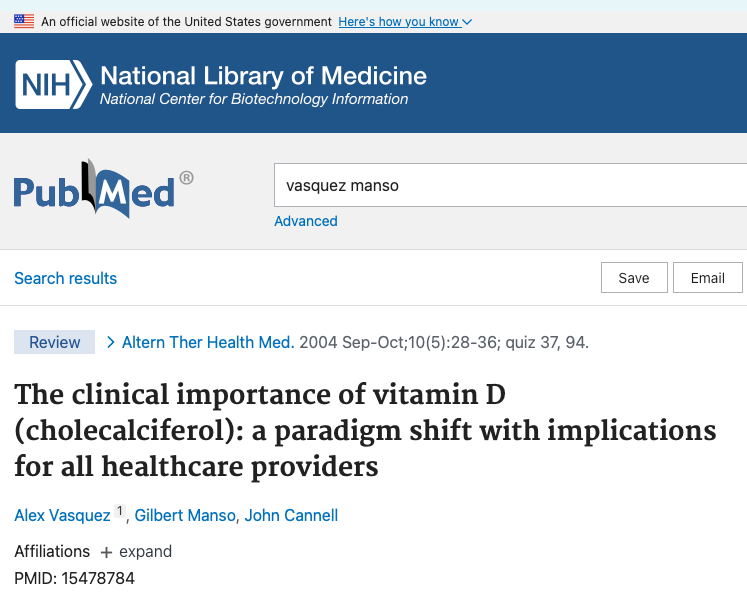
Vasquez A, Manso G, Cannell J. The clinical importance of vitamin D (cholecalciferol): a paradigm shift with implications for all healthcare providers. Altern Ther Health Med. 2004 Sep-Oct;10(5):28-36; quiz 37, 94. PMID: 15478784. https://pubmed.ncbi.nlm.nih.gov/15478784
PDF FULL-TEXT
PDF COMPILATION with updates
PDF CONTEXTUALIZATON with DIET
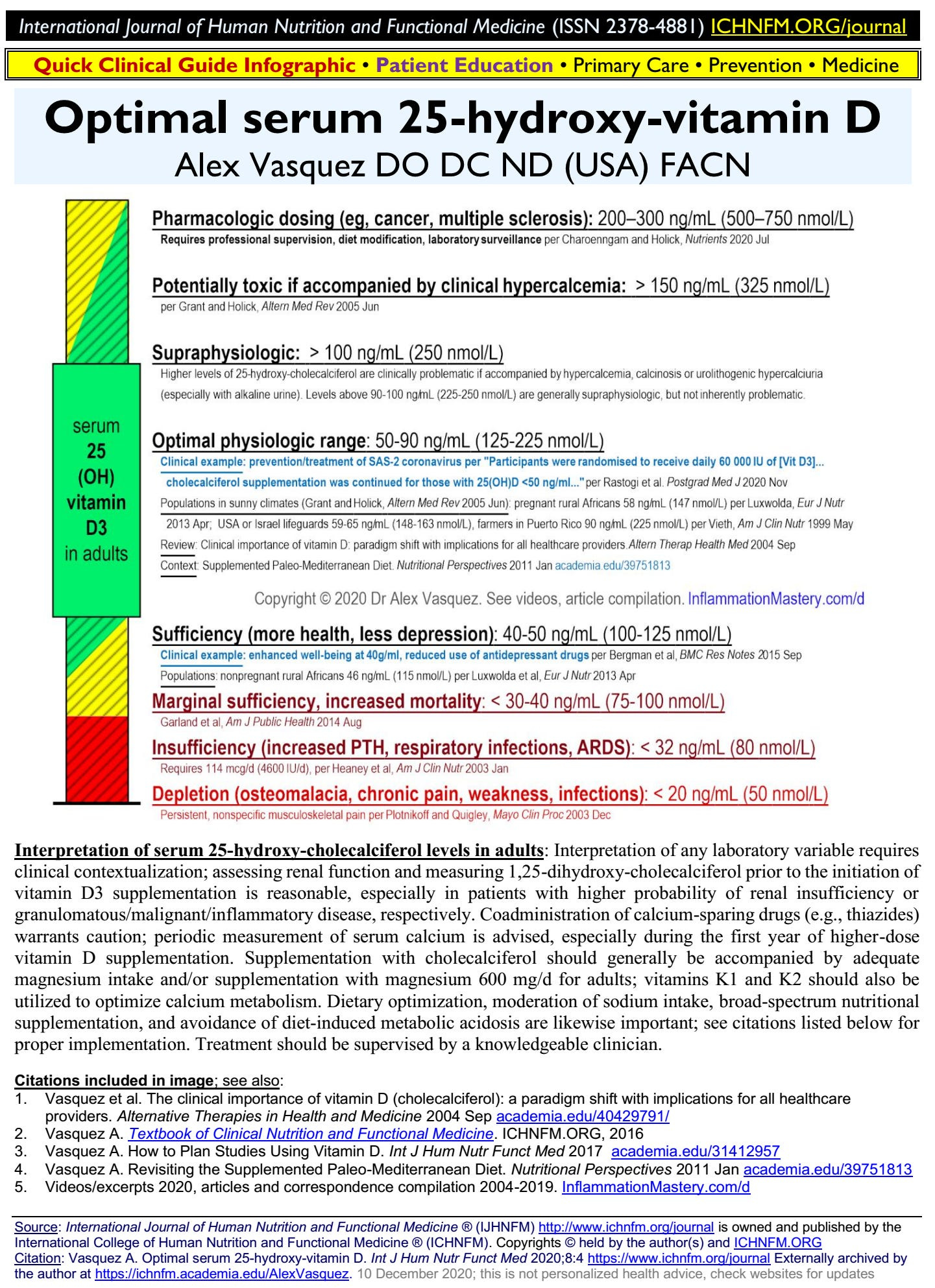
INFOGRAPHIC