

Note: As with many of my articles/videos, this one is being sent for free to everyone subscribed to the email newsletter, and then the page will be archived and paywalled for subscribers. Be sure you are subscribed to the email newsletter in order to receive new articles directly in your email.
TRUE STORY: My wife’s vitamin D level was recently (May2026) measured at 138 ng/ml with a laboratory reference range of 30-100. Should I be concerned?
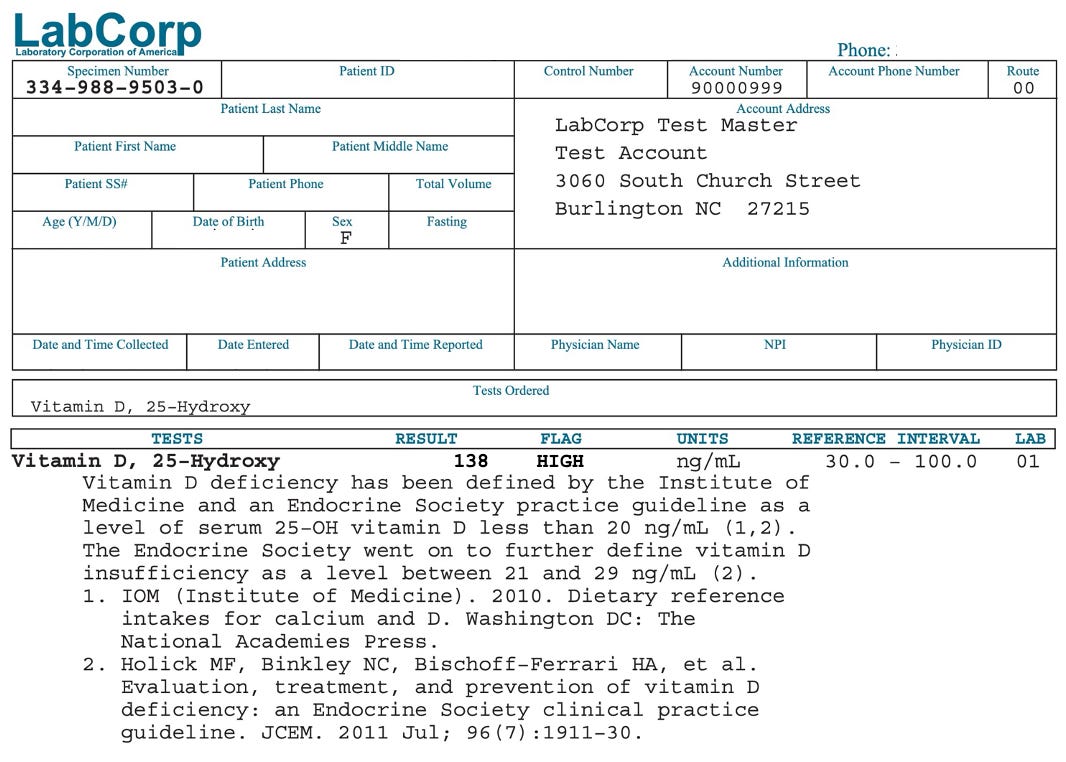
DrV: No, I am not concerned at all.
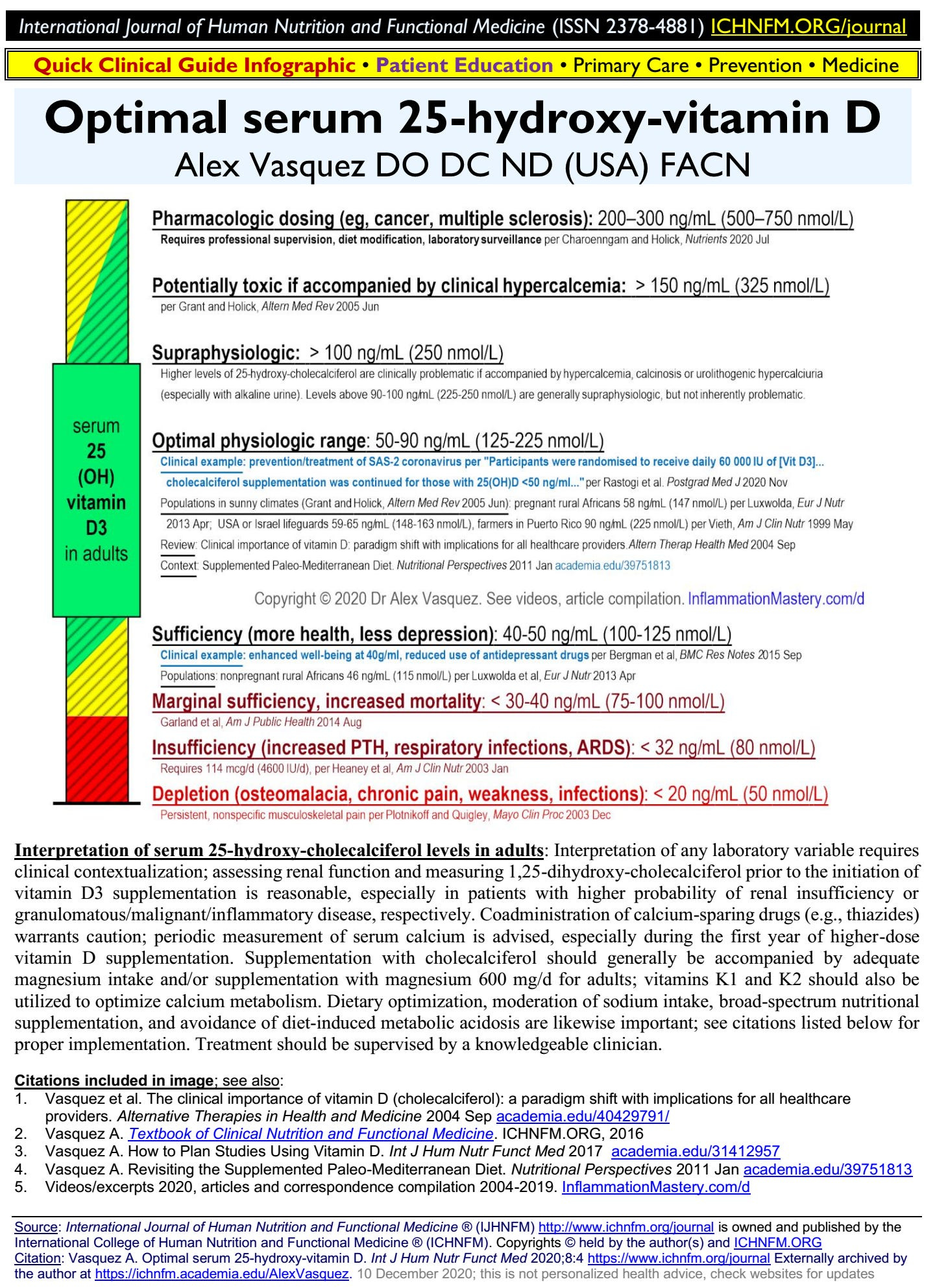
1. Vitamin D is nontoxic by itself, and it only causes problems when it is high enough and combined with other factors to induce hypercalcemia—a high level of calcium in the blood as measured by “serum calcium.”
If I see a high 25ohD level, but the serum calcium is normal and the clinical findings are “nonspecific” ie not attributable to high calcium / hypercalcemia or hyperparathyroidism, then I am not concerned.
A high 25ohD level without clinical problems + without hypercalcemia is not a concern to me. This does not mean that I want to see some absurdly high level, but within some level of reasonableness in terms of clinical picture and blood test results and clinical history, then I'm not going to be concerned about an isolated finding like this. A basic rule in laboratory interpretation is to look at the patient before panicking about a number on a piece of paper.
2. See my previous publications in the PDF provided here and the recent discussions in the pages linked below.

3. Except if accompanied by marked hypercalcemia, an elevated Vitamin D does not “drive calcium levels inside the cells too high”—actually probably the reverse: vitamin D appears to mostly lower intracellular calcium by downregulating the VGCC—voltage gated calcium channel and also by promoting conversion of glutamate to GABA by upregulating glutamate decarboxylase.
4. Vitamin D is considered anti-inflammatory. See my 4th video linked below.
5. Everything has to be interpreted with clinical context—see my recent video tutorial on clinical thinking and risk management. This result can only be interpreted and contextualized by 1) assessing the patient, and 2) looking at serum calcium, 3) possibly measuring urinary calcium (rarely measured) and possibly looking at a 1,25-dihydroxy-vitamin D3 level (very very rarely measured).
6. A more advanced consideration by an experienced clinician would be to ask: If this is not a problem now, then could it become a problem if combined with a future problem?
Dehydration might increase the risk of hypercalcemia and possible renal complications. Likewise by extension: vomiting, diarrhea, febrile illness.
Adding a drug that reduces renal excretion of calcium such as HYDROCHLOROTHIAZIDE could easily cause a problem here.
Research Analysis + Clinical Decision-Making [Introductory VIDEO TUTORIAL + NOTES]
![Research Analysis + Clinical Decision-Making [Introductory VIDEO TUTORIAL + NOTES]](https://substackcdn.com/image/fetch/$s_!n3O6!,w_280,h_280,c_fill,f_webp,q_auto:good,fl_progressive:steep,g_auto/https%3A%2F%2Fsubstack-video.s3.amazonaws.com%2Fvideo_upload%2Fpost%2F197955257%2F10c444c6-d289-47f8-a4b6-f8174bb50b86%2Ftranscoded-00001.png)
Be sure that you are subscribed to the email newsletter to receive the upcoming larger video and the additional videos in this conversation on CLINICAL NUTRITION PHARMACOLOGY: Classes that You Never Received
Vitamin D in the treatment of Autoimmunity: How much, how and why, and justified by what criteria?

Production note: This became a complex page to write because I added the consideration of evaluating vitamin D therapy within the established norms of ethical and professional behavior, rather than simply looking at it out of context, as if it were isolated from other clinical decisions. You will notice this addition toward the end of the page, and I will probably review/and refine that section over the next few days/weeks so you can revisit the page to get any updates, if you wish. Overall, even if it is a bit clumsy for its first publication, I am sure you will be able to understand the major points I am trying to communicate.
Vitamin D3 intakes up to 15,000 IU and serum 25ohD concentrations up to 300 nmol/L on calcium metabolism in a community setting. Dermatoendocrinol 2017

Overall evaluation of this publication: Excellent, definitely contributes to our understanding of the safety and pharmacology of vitamin D supplementation and how we have to use higher doses in the obese