“Older people become smarter and wiser when they learn to burn their own fantasies—when they move more slowly and with more precision, efficiency and effectiveness. … I contend that our fantasies and role-playing are unconscious programs that consume a considerable amount of intellectual bandwidth. … I think that as we get older, our mental processes can become more efficient and therefore more precise and effective when we combine the power of more knowledge and more experience (eg, a more powerful motor) with the efficiency and precision (eg, accuracy, fine-tuning, and less dead-weight) of emotional clarity and mental refinement.” DrV, 19oct2025
I definitely transitioned from my teens to 20s with a superabundance of motivation and “positive thinking”, which in retrospect was mostly based on fantasies and illusions of the way that I thought I could fit myself into what appeared to be a near-perfect world. I cannot regret this time in my life —even if it was based on falsity and naivety— because at least it got me out of the house and moving in a positive direction.
“Perhaps a few people, or at least my friends, will remember that I made my first plunge into life armed with some errors and some exaggerations, but that, in any case, I began with hope in my heart. In the philosophical pessimism of the nineteenth century, I recognised—who knows by what by-paths of personal experience—the symptom of a higher power of thought, a more triumphant plenitude of life, than had manifested itself hitherto…” Nietzsche, in section 2 “WE ANTIPODES” in The Case of Wagner
As you would expect, Nietzsche had plenty to say about this youthful condition of being motivated by naivety, lack of experience — in this sense, he uses the word “unhistorical” to mean baseless and illogical, albeit passionate:
What deeds could man ever have done if he had not been enveloped in the dust-cloud of the unhistorical? Or, to leave metaphors and take a concrete example, imagine a man swayed and driven by a strong passion, whether for a woman or a theory. His world is quite altered. He is blind to everything behind him, new sounds are muffled and meaningless; though his perceptions were never so intimately felt in all their colour, light and music, and he seems to grasp them with his five senses together. All his judgments of value are changed for the worse; there is much he can no longer value, as he can scarcely feel it: he wonders that he has so long been the sport of strange words and opinions, that his recollections have run around in one unwearying circle and are yet too weak and weary to make a single step away from it. His whole case is most indefensible; it is narrow, ungrateful to the past, blind to danger, deaf to warnings, a small living eddy in a dead sea of night and forgetfulness. And yet this condition, unhistorical and antihistorical throughout, is the cradle not only of unjust action, but of every just and justifiable action in the world. No artist will paint his picture, no general win his victory, no nation gain its freedom, without having striven and yearned for it under those very “unhistorical” conditions. If the man of action, in Goethe’s phrase, is without conscience, he is also without knowledge: he forgets most things in order to do one, he is unjust to what is behind him, and only recognizes one law, the law of that which is to be. So he loves his work infinitely more than it deserves to be loved; and the best works are produced in such an ecstasy of love that they must always be unworthy of it, however great their worth otherwise.
I am fortunate to have been able to attend the educational programs that I did, with medical school arguably being the most important in terms of “social esteem” (but not clinical value). Sure, I was lucky —and happy, or at least enthusiastic while losing my naivety— for the most part, but I was also working my ass off within a sadistic educational model that mostly had us jumping through hoops and not really learning what we needed to learn to be good clinicians. How unfortunate that jumping through worthless hoops in service of the drug paradigm would be seen as something worthy of high social esteem; for me, medical school was more like visiting an alternate reality for the sake of experience, with the added benefit of resulting in some tangible professional benefits:
I went to medical school for the professional reason that I wanted more opportunities especially as I was then planning to continue my clinical practice in Texas, which had a very narrow range for chiropractic practice and zero licensure for naturopathic medicine.
I went to medical school for the personal reason to see, experience, and deconstruct-so-that-I-could-later-reconstruct-and-improve the educational model of famously known as “medical school.”
I went to medical school for the emotional reason to put myself though the most difficult experience I could find, with the hope of losing my naivety, with the hope of becoming less emotional, with the hope of seeing and acting with greater clarity.
After dedicating myself to achieving the career of my dreams for 20 years, I did finally achieve that position in my early 40s. On paper, I had the perfect position at the perfect school in the perfect city and I should’ve been perfectly happy. In retrospect, of course, those were the most overworked and gaslit years of my life and I suppose in some way I was lucky that I was fired unceremoniously overnight by email and relieved of my misery. The profession that I had dedicated myself to for 22 years, and the school that I loved for 20 years, turned out to be just an empty shell of false promises, fake sincerity, and meaningless handshakes.
Song: “no me acostumbro” = I can’t get used to it
ORIGINAL: Los años mas terribles que me han pasado, Y mientras los leía me ahogaba en llanto; No me acostumbro no, no me acostumbro; Todavía al acostarme la recuerdo; Y al despertar amor, tiemblo de miedo; Al descubrir que sólo estaba en mi sueño
MY TRANSLATION: The most terrible years that have ever happened to me; And when I look back at them, I am choked with tears; I can’t get used to it; I still remember those times when I go to bed; And when I wake up, …I discover that it was only in my dreams
Thank you for supporting this archive of information for the cost of a coffee while I am working—about $4.20—for the hours, days, months and years developing this archive which now contains more than 1,000 pages and hundreds of hours of videos on a wide range of topics including Clinical Nutrition (including the Vitamin D series of Videos and Scientific Publications), Antiviral Strategies, Microbiome+Dysbiosis (CME series of >12 videos), Functional Medicine (conference videos) and Pharmacology (of Vitamin B12 and Pediatric Injections,.. Leadership, Critical Analysis of Research and Social Events, architecture, music (Celibidache), philosophy, and a few tutorial videos on fun topics like how to select a good wine/whiskey (and minimize the risks)! HealthyThinking.substack.com includes a wide range of topics including music, politics, architecture, logic, philosophy, recipes (ie, “everything”) plus “Health Homework” (series) to inform and remind you about important health-promoting actions…whereas InflammationMastery.substack.com attempts to be more/strictly clinical and specific to book updates, clinical research and protocols.
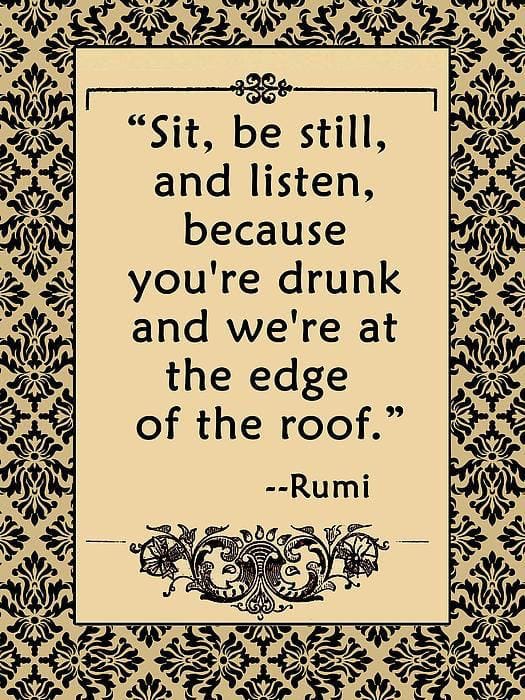
“Sit, be still, and listen, because you’re drunk and we’re at the edge of the roof.”
Rumi (1207-1273) commonly considered to be the greatest of the Muslim poets
My grandmother was right
I remember someone once telling me – I think it was my grandmother – that “life gets better as we get older.” I didn’t know if that was true or just some delusional bullshit, but as I am now in my 50s, I find it to be true. I would never go back to my 20s or 30s or even my 40s. Even into my early 40s, what seemed to me as intensity and passion was mostly my residual naivety mixed with being drunk on testosterone. I would never want to go back to that.
“Once, you suffered passions and called them evil; now you have only your virtues left—your virtues came out of your passions. Once, you had wild dogs in your cellar, but in the end they turned into birds and lovely singers. Out of your poison, you brewed your balsam, and you have nothing evil left in you except if it be the fight among your virtues.” Nietzsche in THUS SPOKE ZARATHUSTRA
Miserable millionaires
The millionaire men I know are the most miserable people I know because they are chained by “golden handcuffs“ to their occupational positions and social status. Sure they are millionaires, but they might as well be imprisoned, as they are trapped within their self-imposed narrow range of life experiences.
I notice a difference between myself and many other older people, especially men, who I either have known in the past or know currently. The most miserable people I know as older adults are the ones who are still chasing their juvenile fantasies—they are well into their 60s and 70s and still striving to “look young” and “be in charge” instead of being happy, creative, free and generous. The worst example is that of a multimillionaire I know who has not a single friend, whose only activities are 1) office work, 2) reading alone at home, and 3) occasionally going to the club for a massage—everyone at the club knows him as being bitter, condescending, and utterly alone and miserable; he could have easily cashed-out for USD$110MILLION but he stayed trapped in his cyclical role so that he could rule in dominion over his employees —over an Italian dinner he told me, “I hate all my employees, and I could fire any of them at any moment”— who he treated as pawns in his manipulative games.
What would your life look like if you were completely free from role-playing?
What would a free person do?
What would you do if you felt free—if you fired yourself from your social role?
“Even at this moment I look out upon my future—a broad future!—as upon a calm sea: no sigh of longing makes a ripple on its surface. I have not the slightest wish that anything should be otherwise than it is: I myself—the person I am now—would not be otherwise.” Nietzsche, Ecce homo—thus spoke the man
Older people become smarter and wiser when they learn to burn their own fantasies—when they move more slowly and with more precision, efficiency and effectiveness.
I contend that our fantasies and role-playing are unconscious programs that (nonetheless and despite their mostly-subconscious existence) consume a considerable amount of intellectual bandwidth. We think in alignment with our fantasies and paradigms of what we expect life to be, whereas our thinking would be more efficient and effective if we focused on and aligned ourselves with reality itself. Our naive thinking misdirects us. Our “hope” is a false target, because it is the wrong target, a target that does not exist; we should be focused on a direct line to reality, not the roundabout meandering path. I think that as we get older, our mental processes can become more efficient and therefore more precise and effective when we combine the power of more knowledge and more experience (eg, a more powerful motor) with the efficiency and precision (eg, accuracy, fine-tuning, and less dead-weight) of emotional clarity and mental refinement.