

Many articles in this genre of molecular science are actually quite good, in contrast to many of the articles in clinical science/guidelines that are mostly absurd because they are generally pushing paradigms to push profiteering pharmaceuticals.
In many academic-clinical programs (ie, medical school, residency programs, chiropractic college) professors will commonly attempt to hold meetings called “journal clubs” which are supposed to be casual but insightful discussions of recent or important journal articles. Most of these “journal clubs” are a complete flop because the students don’t have the ability to engage with the material and the professors don’t have mastery over the material either, or they simply use the exercise to fill time and not have to create course material. So basically, the students quietly nod in agreement while the professor gets the day off for attending his/her own zero.
This attached article from the medical school in San Antonio TEXAS is quite good even if not innovative, per se. Sometimes, the innovation comes not from the article, but from the reader. Like I said recently, for the mastery of chronic pain, the geeks are going to win this one.
This article is a nice review, but it does not say anything that other articles have not already said, and for that reason it serves as a great review—and perfect for this week’s virtual JOURNAL CLUB.

“Current research has yet to fully explore the complex interactions and precise roles of different calcium Ca2+ channel subtypes in vivo, and bridging this gap will be critical to developing novel therapeutic approaches targeting specific Ca2+ channels, which may lead to more effective pain relief strategies, particularly for chronic pain conditions. Progress in this direction holds the promise of unveiling new insights into pain mechanisms and opening avenues for innovative pain management techniques.”
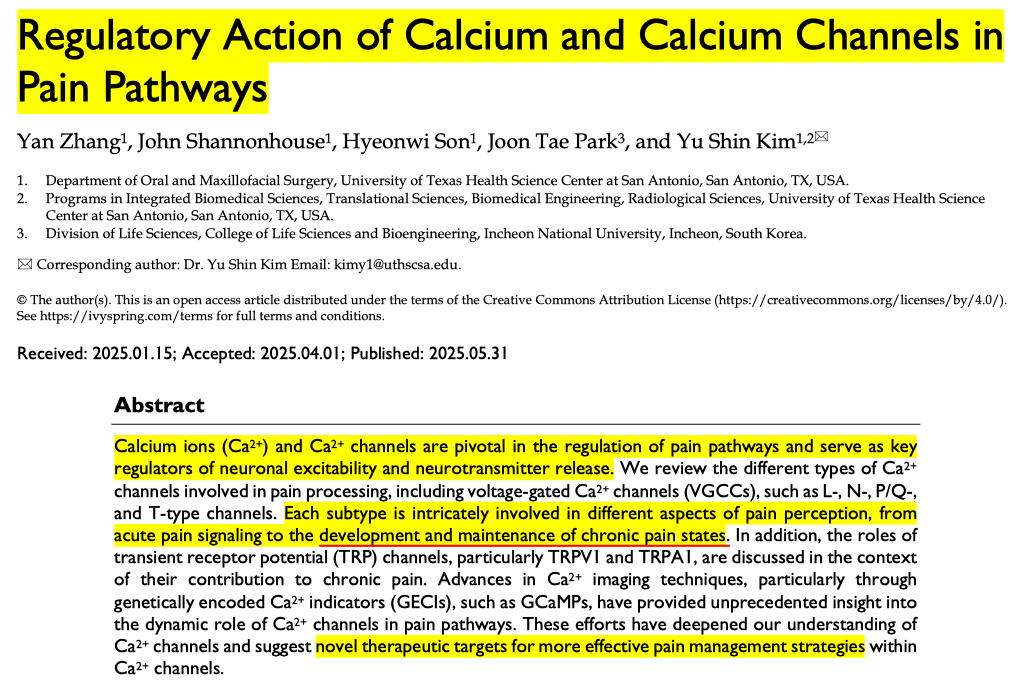
Zhang Y, Shannonhouse J, Son H, Park JT, Kim YS. Regulatory Action of Calcium and Calcium Channels in Pain Pathways. Int J Biol Sci. 2025 May 31;21(8):3726-3739. doi: 10.7150/ijbs.110504 PMC12160918