

Productivity and Health-Protection both require MACROstrategies and MICROstrategies:
MACROstrategies: Overarching plan for ensuring that the major tasks are included on a daily/regular basis.
MICROstrategies: Tactics for the smaller details that attend to the larger strategies and goals.
Life Effectiveness MACROstrategy:
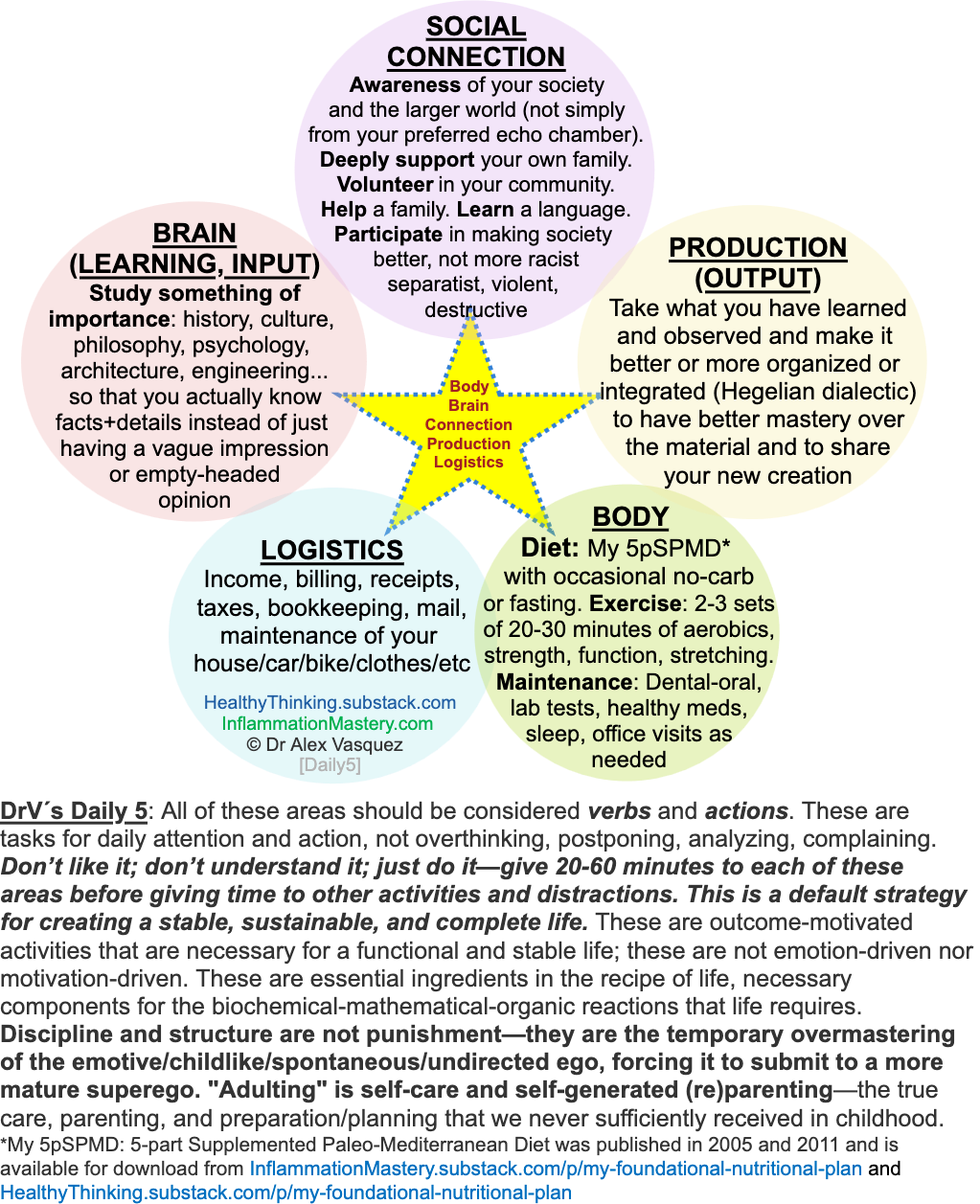
Illustration of 5 important activities for each day
One of my best productivity tools isn’t a “hack” or an “app” or anything of those sorts. It is the realization that protection and progress are daily events, even—and especially—when they might only need 20 minutes of time and effort.
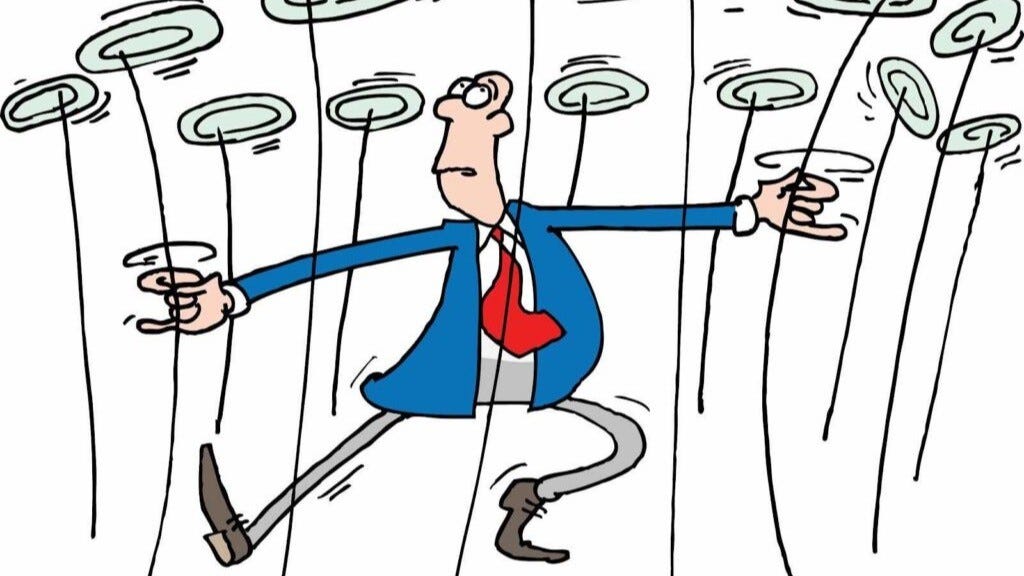
For most of us when we are young, we get along quite well without having to “strategize” because most of us are only juggling a handful of responsibilities, nearly all of which center exclusively on ourselves. But as we develop more complex lives and take on more responsibilities and relationships beyond our personal needs (to include those of spouses, extended family, businesses, employees, bookkeeping, accountants, attorneys, consultants, business partners, social engagement), many of us find the need for strategies and tactics to help us maintain attention and balance as we juggle the spinning plates that we have either chosen or which adult life imposes upon us.
Starting in late 2025, I began organizing the most important activities of the day into the following five categories:
Brain: learning, input, peace
Body: diet, exercise, medicine as needed
Production: apply learning to work, creativity
Connection: maintain relationships, listen to others, participate in the community
Logistics: all that boring bullshit like taxes/accounting and bill-paying and car/house maintenance that demand their due time and attention
Infographic updated 21Jan2026: PDF and JPG/JPEG versions are provided below for subscribers
Problems with my previous system (which at least was a start in the right direction)
Structured but incomplete: For example, for a few years I scheduled my “logistics” for the first week of each month; this was dedicated time and attention mostly for paying bills such as monthly utilities. But this did not include anything related to taxes or bookkeeping, which could have been included to keep this behemoth manageable instead of allowing it to grow in the dark to an unmanageable size every year.
Did not allow for schedule conflicts and flexibility: Additionally and importantly, by scheduling this for a specific time each month, I was functionally screwed—my system was broken—if that specified time was occupied or distracted with another event such as travel. Also, if I happened to have a nonscheduled day free from other tasks, the idea of working on billing/logistics might not occur to me if I have it organized and sequestered into a specific pigeonhole.
Infographic updated 21Jan2026:
PDF and JPG/JPEG versions are provided below.
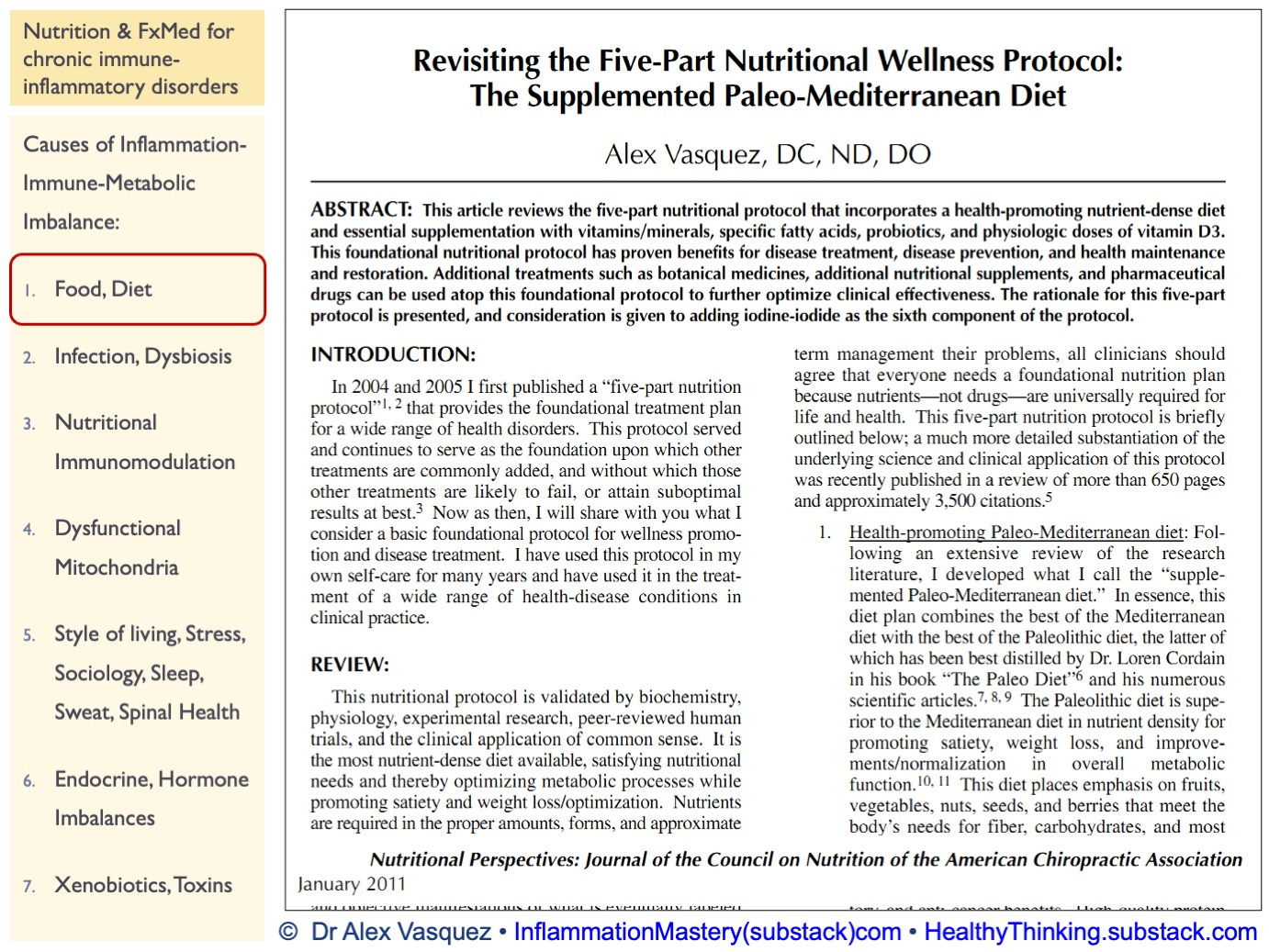
The only part that needs explanation is “my 5pSPMD” which I have described in the attached PDF excerpted from IM4 textbook—see PDF provided below.
Life Effectiveness MICROstrategy:
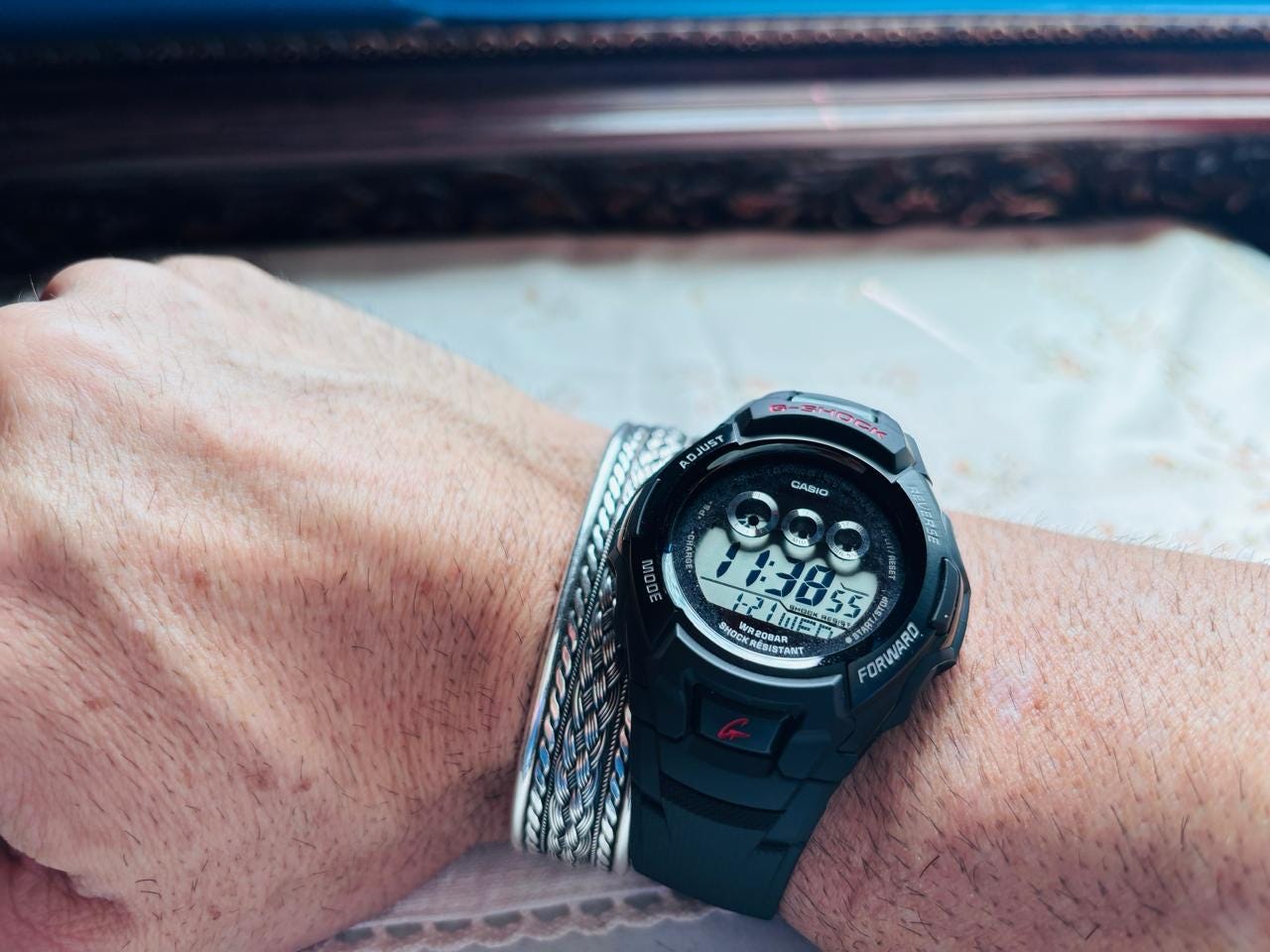
For me, adding a digital watch with alarms helps me stay on track and get the exercise/bodytime that I need.
I recently provided a lengthy multitopic video that included most of the important considerations on watches, especially men’s watches. In that video, I listed the 4 most common categories of men’s watches as: 1) formal, 2) casual, 3) sport-dress, and 4) mud. Among high-utility high-durability men’s watches, Casio’s G-Shock is clearly one of the most iconic for those who want plastic/resin, and their line of ProTrek provides the same or more utility and functionality in a metal case, usually titanium, which as a metal is strong, lightweight, and destined to become lackluster and ugly after years of hard use.
I’ve had to use digital watches (Casio ProTrek) since I was in medical school 20 years ago because I had so many things to keep track of that I actually needed to have immediate access to stopwatches, countdown timers and five alarms in addition to the obvious day and date. Beyond medical school and into my postgraduate life, I still find very useful the ability to time-measure events, which to the uninitiated might sound a bit neurotic, but actually becomes liberating. For example, just yesterday: I was bothered by the fact that I had to wait in line at a store when the number of waiting customers clearly outnumbered the available cashiers. So in order to quantify my frustration, I started my stopwatch only to find out that my fastidiousness1 was worth only 10 minutes in line, which is negligible in the grand scheme of today’s global chaos. Throughout many different experiences, I find that whenever I feel compelled to time something, I usually find out that it wasn’t so bad after all, and this has been most obvious when I have to do tasks that I absolutely despise because most of these tasks in retrospect only needed 10 to 15 minutes of my attention rather than 30 to 90 days of my procrastination—this insight has been immensely helpful in overcoming my internal resistance to life’s obligatory bullshit: junk mail, junk messages, and endless encounters with Dunning and Kruger.
These days, I use the 4 daily alarms set at 2-hour intervals to remind me to get up from my desk, exercise, stretch, and drink water—this has been immensely helpful in promoting productivity, physical and mental health and better overall quality of life for me.
I’ve found that the limiting factor for me if I want to maintain a routine of daily exercise isn’t the exercise itself but rather the pain and stiffness that result if I neglect the accompanying stretching, especially my neck and legs. Having an alarm sound several times per day invites me to stop whatever I am doing, break the trance of work/focus, and get a few minutes of exercise+stretching. For me, this has resulted in better fitness, more strength, dropped body fat, less pain and more mental focus.
The Doubles Gambit: Watching vs Wristing
Double-watching (wearing 2 watches on the same wrist) became popular in the 1980’s for a short time (thankfully) among American teens, generally by wearing two Swatch brand watches next to each other. We did a lot of dumb things in our GenX teen years, and this was one of them—you can see a level of cultural insanity throughout popular culture in the 1980’s which I attribute to 1) Reagan’s inversion of the economy, and 2) the constant daily fear-mongering about nuclear annihilation in a going-to-happen-any-day-now war with Russia.

Double-wristing (wearing a watch on each wrist) has been popular in the military2 for decades, and has become popular again recently among people who want to wear an attractive/classic/mechanical watch on one wrist and a more functional or “smart” watch on the other.

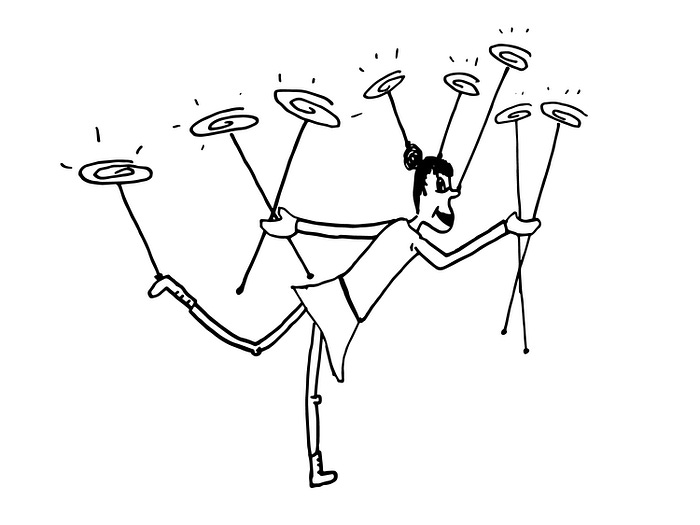
For most of us when we are young, we get along quite well without having to “strategize” because most of us are only juggling a handful of responsibilities, nearly all of which center exclusively on ourselves. But as we develop more complex lives and take on more responsibilities and relationships beyond our personal needs (to include those of spouses, extended family, businesses, employees, bookkeeping, accountants, attorneys, consultants, business partners, charities), many of us find the need for strategies and tactics to help us maintain attention and balance as we juggle the spinning plates that we have either chosen or which adult life imposes upon us.
I hope that the diagrams, articles (PDF), and ideas provided here are useful for you in creating a good life for yourself.
For details on “my 5pSPMD” , see the video recently re-posted with the updated video-article series on Dietary Protein:
Part 1 VIDEO: Overview, history, and 1-hour conference presentation (video, linked here and below)
Part 2 VIDEO: The eight (8) major considerations in the conversation on dietary protein (video, linked here and below)
Part 3: Dietary Protein: Spanish sardines, cheese, pesto, and coffee
Part 4: Low-protein diets cause losses of body cell mass, muscle function, and immune response
Part 5 VIDEO: Cheese, other common milk-based foods such as kefir and yogurt; accessory nutrients and bioavailability
Part 6 VIDEO: pH alkalinization problems with Ketogenic and High-Protein Diets
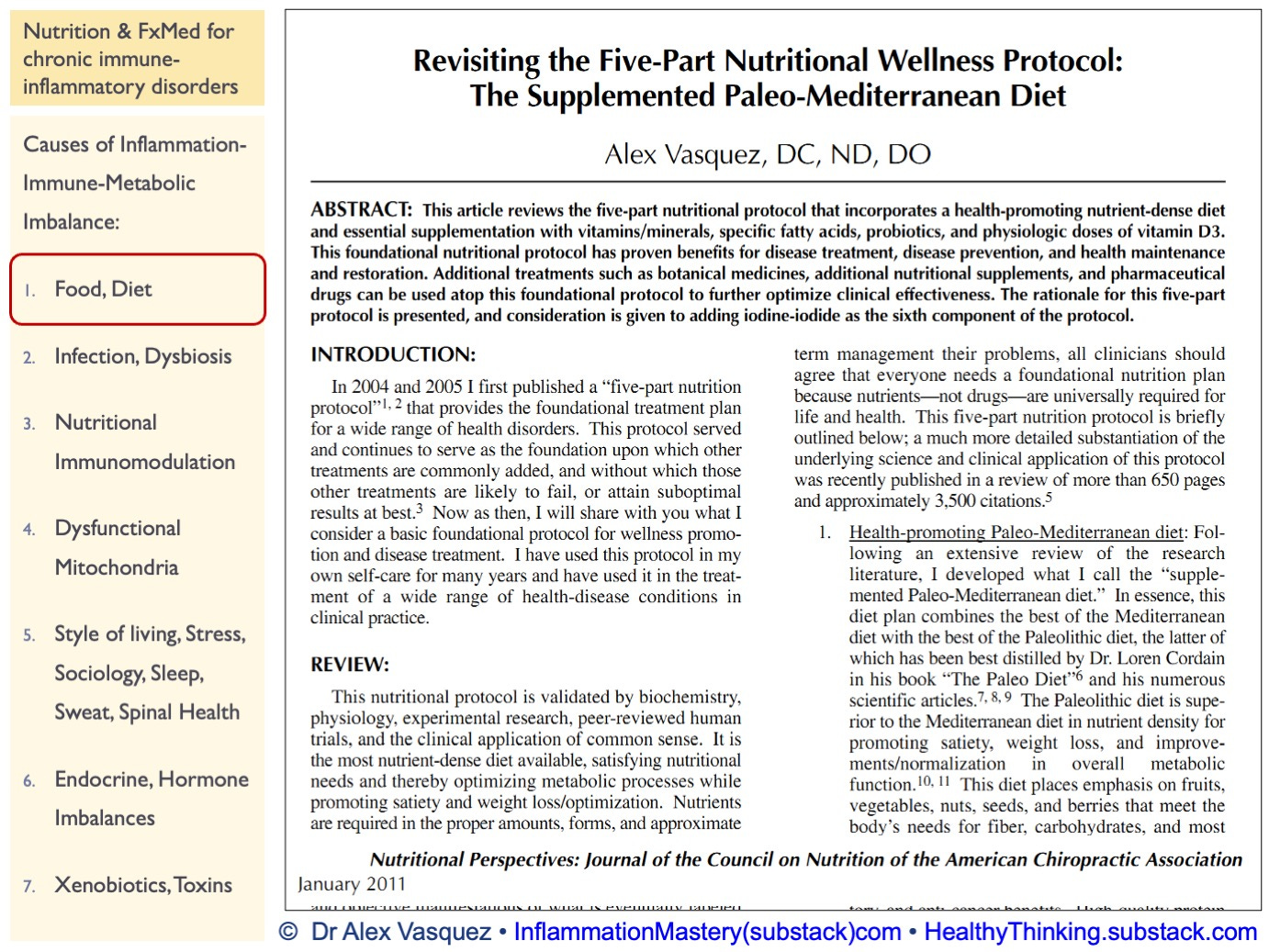
DAILY FIVE (v3): PDF and JPG/JPEG versions are provided below:
REMINDER: Videos for the HUMAN MICROBIOME AND DYSBIOSIS IN CLINICAL DISEASE series are linked below:
Can you answer these 10 questions on dysbiosis and microbiome?
VIDEO with discussion of QUESTIONS and ANSWERS 1-5 with Test-Taking Strategies
QUESTIONS and ANSWERS for Dysbiosis & Microbiome (6-10) with Test-Taking Strategies
Microbiome Dysbiosis (1) Course Overview and Introduction to Major Concepts and Mechanisms
Microbiome Dysbiosis (2) Physiologic and Pathologic Mechanisms of Dysbiosis and Subclinical Microbial Colonizations (VIDEO:1hour,15minutes)
Microbiome Dysbiosis (3) Prototypes of Dysbiosis-Induced Disease(VIDEO:1hour,42minutes=102minutes)
Microbiome Dysbiosis (4) Conceptual Expansion Exploring Clinical Testing, Microbial Relevance and Irrelevance [VIDEO:1hour,18minutes=78minutes]
Microbiome Dysbiosis (5) Microbial Consequences in the Mouth, Oral Cavity[VIDEO:1hour,44minutes=104minutes]
Microbiome Dysbiosis (6) Microbial Imbalances in the Respiratory Tract and Sinuses [VIDEO:1hour,35minutes=95minutes]
Microbiome Dysbiosis (7) Dysbiosis by Location—Genitourinary Tract
Microbiome Dysbiosis (8) Dysbiosis by Location—Blood, Tissue, Parenchymal Dysbioses
Microbiome Dysbiosis (9) Dysbiosis by Location—Skin and Environmental Dysbiosis
