

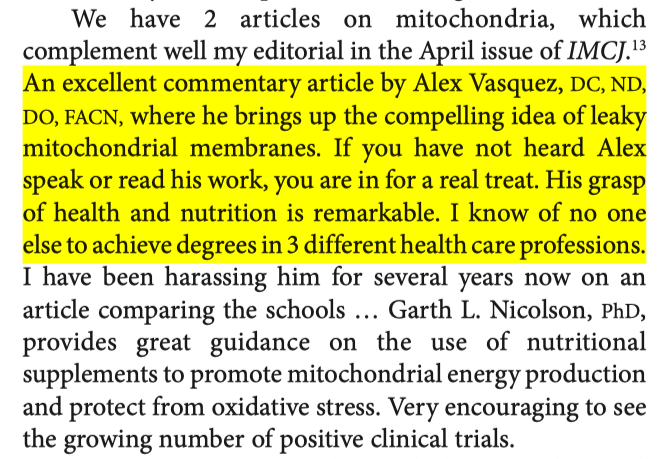
PDF article provided below, as cited in the video—
you know it is a good article if it talks about me and says nice things :-)

Today’s video:
This series will focus on ANALYSIS AND ACTION
What tests in what context
What are you going to do about it
Any social or “big picture” considerations
My history with this material:
Yes, we actually had dedicated classes in Clinical Laboratory and Patient Management in chiro/ND school while none of this was mentioned in “medical school”—just like Radiographs, Clinical Therapeutics, EENT, and a bunch of other important topics that needed dedicated courses.
Decades of reviewing lab tests in patient care.
Most common and important lab tests are reviewed in Chapter 1 of Inflammation Mastery 4th Edition.
Click here to see the first few pages, including the table of contents and index (size: 6 MB)
Click here for a larger sample with photos (size: 43 MB)
I have taught many courses that include laboratory interpretation including Orthopedics, Rheumatology, and Clinical Laboratory Medicine—the latter for about 4 or 5 years in a Master’s / Postgraduate program for doctors, and by the final year (2011) the class was actually competent—those course notes are now included in Inflammation Mastery 4th Edition.
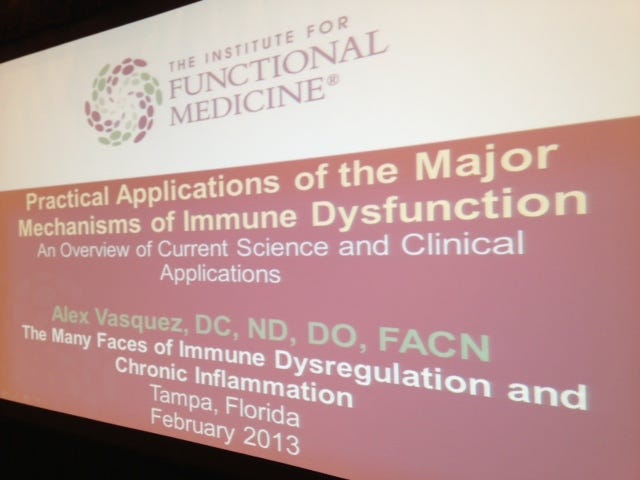
I taught theLaboratory Assessment lecture of our 3-instructor Immune/Inflammatory Disorders Conference at the Institute for Functional Medicine (where I was Faculty since 2003) until 2013 until IFM President David Jones “Mr Spirituality and Community” sent me a hyperarrogant email demanding free access to my 2013 International Conference on Human Nutrition and Functional Medicine, which I of course rejected out of respect for my own work (I paid for the entire conference myself, including venue, printed notes, travel, hotel, food, and generous compensation for the presenters) and also respect for my graduate students, some of whom were single mothers working up to 2 jobs to pay for their tuition; later that year, IFM announced my replacement on Facebook but never had the courage to tell me directly. So much for my 11 years of nonprofit “service” and helping grow the organization from a time when they could not even pay their faculty!
Clinical-Laboratory Assessment of Chronic Pain:
You have to know the “core competencies”—the more you know, the better.
You have to have systems and strategies for patient assessment, this demonstrates that you know what to look for (eg, what is likely, and what is dangerous) and that you have thought out the process ahead of time
You have to look for and try to make more than one diagnosis at a time; then each diagnosis carries its responsibilities. Just because you find a diagnosis does not mean that you found the only diagnosis— “Patients are entitled to more than one disease.” Ron LeFebvre DC
Real experts know and respect real diseases, and they rule-out real diseases before looking for “functional” problems
You must have backup plans for your strategy because sometimes your first strategy does not work perfectly.
What if your patient refuses lab tests?
What is the difference between CHRONIC PAIN with a ferritin of 4 vs a ferritin of 450, assuming a benign CRP et al?
Most common and important lab tests are reviewed in Chapter 1 ofInflammation Mastery 4th Edition.


LABS for CHRONIC PAIN (5) What is the probable diagnosis and next lab test?

Image and case presentation from PMC1114910 with full-text PDF provided below:


Can you answer these 10 questions on dysbiosis and microbiome?
VIDEO with discussion of QUESTIONS and ANSWERS 1-5 with Test-Taking Strategies
QUESTIONS and ANSWERS for Dysbiosis & Microbiome (6-10) with Test-Taking Strategies
Microbiome Dysbiosis (1) Course Overview and Introduction to Major Concepts and Mechanisms
PDF article provided below as cited in the video—you know it is a good article if it talks about me and says nice things :-)


